Oklahoma State University Athletics
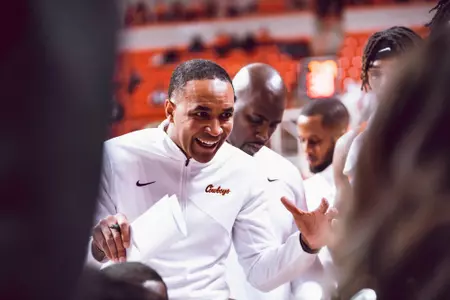
Photo by: OSU Athletics
Boynton's Battalion: Larry Blunt Brings Elite Experience at Prep School, Collegiate, and Professional Levels to Stillwater
October 28, 2022 | Cowboy Basketball
One phone call, one night, one new team – how far would you go to chase your dreams?
For Larry Blunt, the pursuit of his dream has taken him from yard lines to courtsides, Division III to Canadian ties and coaching five-star prospects to stopping at a Stillwater sign.
Blunt, one of three assistant coaches hired by Mike Boynton prior to the 2021-22 season, returns to Oklahoma State men's basketball this season holding a prolific coaching background, both in professional and collegiate settings, experience building a premier Canadian prep school program, home to a bevy of elite-level prospects, and time playing on the football side.
Yard Lines to Courtsides
Courtland, Va., – population 1,679.
The small-town scene thrives in Courtland. With a tight-knit community and few sights to see, Friday night calls for a meeting point within the town. It marks the kickoff for high-school football.
As a native of Courtland, Larry Blunt was no stranger to the quaint experience that is found in small town living. With football embodying the community's pulse and his father previously playing football for Virginia Tech – Blunt was destined to play on grass turf. But, growing up with basketball, the hardwood held his true passion.
Standing 5-foot-11 in his senior year of high school, Blunt was at a two-sport crossroad. With collegiate play at the top of the menu – football was his next destination.
"I grew up in a football town," Blunt said. "I was blessed to play at Southampton High School, a very storied football program that we had a lot of success both individually and collectively. Growing up my father coached high school football after playing at Virginia Tech, so football was everything in our house.
"Growing up in a small town you play multiple sports, and although I decided to play college football, I was always incredibly passionate about the game of basketball"
By graduation, Blunt's vision had come to light, committing and play for Elizabeth City State University, located in Elizabeth City, N.C. With two varsity letters in his first two years, Blunt transferred back in-state as an upperclassman, joining the team at James Madison University.
However, football wasn't the only sport Blunt was playing in Harrisonburg, Virginia.
"When I arrived at James Madison, I had a grown to 6-foot-4 and had some conversations with the coaches about playing basketball," he said. "They were looking for walk-ons off the football team because they had some injuries on their roster. I did not play on the team, but through that process, I got to know some of the assistant coaches on their staff. Essentially, when they had nine guys and needed a tenth, I was the football player that wouldn't knock everyone over or talk too much trash, but had enough feel, athleticism and competitiveness to play without getting anyone hurt."
"Through that process, I got to know all the assistant coaches and I let them know that I wanted to coach."
A coach on the staff let me know that Eastern Mennonite, a Division-III program, was looking to find a volunteer for their basketball team. With the two campuses separated by only 4.3 miles and Blunt holding a strong passion for the game – a door opened for him. He took it right away.
"They [The James Madison's staff] said, 'There's a D-3 school, Eastern Mennonite; and that they had an opportunity available," Blunt said. "They told me that they hired a new coach and needed a volunteer assistant.' So, I was like, 'Sure. I'll sign up.' They told me that I had to show up the next day at eleven o'clock to meet the coach. The very next day, we had our first team meeting. I show up, and in comes a young lady, and I'm like, 'Woah. Wait a minute.' In comes another young lady, and another young lady. Lo and behold, it was the women's staff at Eastern Mennonite. I had no idea initially, but it was my first college opportunity, and it was going to be working with the women's staff at Eastern Mennonite University."
Blunt's transition back to basketball was seamless.
After being a part of Eastern Mennonite's staff in 2005-2006, he accepted an offer to reunite with former James Madison staffer and former Duke standout, Robert Brickey, at Division-II program Shaw University.
Blunt continued to generate success at the Division-II level working under Brickey. After two seasons as an assistant at Shaw, Blunt returned to Virginia, taking an assistant role at Division-III program Hampden-Sydney.
"We [Hampden-Sydney] had a lot of success both on and off the court," he said. "We were fortunate to have great young men that did a lot of winning. I was working for a great friend and mentor, at a great institution that was close to home, but had a strong desire, after year four, to work at the Division-I level. So, at that point, I discovered a loophole in the rules that allowed me coach AAU while concurrently being a full time Division III assistant. This helped me immensely because I was getting to know all the players, and frankly, some of the relationships developed allowed us to beat Division-I schools for recruits."
One Phone Call, One Night, One New Team
Larry Blunt's phone rang.
On the other end, Robert Brickey – who Blunt previously worked under at Shaw – was in need of some assistance.
Brickey, who was the then head coach for the Oshawa Power, a Canadian-based team in the NBL, had to step away from the team to take care of his ill mother. With Brickey headed back home, the Power needed a head coach, and they needed a new one by eight o'clock the next morning.
"[Robert] Brickey was in the front office and said, 'Look. We need a coach tomorrow,' Blunt said. Brickey told him, "'If you are interested and want the job, that we need you to here (In Canada) by at eight o'clock in the morning.' I knew that these opportunities didn't come often, but I also knew that there was some risk to moving to a new country and giving up a stable job that was close to home.
"I thought, It may be a creative way of getting to Division I. I shared all that with Dee Vick, who was my boss at the time (and still a dear friend to this day), and he was very supportive. I also called and had a conversation with my parents who gave their blessing as well. With their support I decided, to take a chance and move to a new country."
"I knew that because of my relationship and trust of him [Robert Brickey] and the level of talent in Canada, more specifically to the grassroots and AAU programs, where there was an abundance of talent. I also knew that a lot of those kids were excelling in the U.S., so I thought, if I could just get to Canada, I could continue to get to know people and cultivate some new relationships.
In the span of 24 hours, Blunt received a job opportunity, packed all of his belongings, boxed up 4 ½ years of efforts at Hampden-Sydney, put his keys in the ignition and shed all sorts of tears driving 12 hours (653 Miles- 10050 KM) to Oshawa, Ontario (Canada), all in pursuit of his Division-I dream.
On Nov. 10, 2012, Blunt made his home debut for the Power. In his opener, the Power defeated the Windsor Express in a 19-point victory, 106-87.
The Nov. 10 game marked a three-way tie for the Power's largest margin of victory in franchise history.
Operating both as a head coach and with professional players for the first time in his career, Blunt led the Power to the most wins in franchise history during the 2012-13 season.
Even with newfound success, Blunt was in search of pathways to make an impact in youth and collegiate circles. With a bevy of positive reports on the state of Canadian basketball – his wheels began turning.
Prep School Pioneer: The Assembling of an Orchestra
At the conclusion of the 2012-13 season, the Oshawa Power folded as a franchise, leaving Blunt back on the job hunt. With a successful resume and the National Basketball League, the Power's former league, still afloat, Blunt was looking to find his way back in the league.
With one sit-down interview, 15 high school kids and a workout – Blunt's career trajectory had been altered forever.
"When I was coaching the Power, our team folded," Blunt said. "We were fortunate, we had success, so the Tipping family, who was running the actual institute, were trying to have a professional team in that league, the National Basketball League of Canada. So, they were bringing me in for an interview to potentially be their new coach. When I got there, part of my interview, unbeknownst to me, was to put 15 high-school kids there through and on court workout. They had just hired another coach, but he wouldn't be there for a few weeks, and they needed someone to work these kids out.
"Part of my interview for their professional team was to work out these kids. I had no idea who they were. I was like, 'Wait a minute, what is this?' So, they explained what their thoughts were. They were going to attempt to use the European model and then have high-school kids try to bridge the gap from High school (Club) to playing professionally. It was going to give kids in the opportunity to stay in Canada and play basketball against elite level competition.
"When they said that, my wheels started turning. I was like, 'Wait a minute, the heck with this pro team. My passion is helping young people.' I also had relationships because of my time in Canada so that I could help attract some of the elite-level talent that was leaving Canada for premier prep schools. In addition, my relationships with teams in the United States would allow us to schedule games that would allow us the opportunity to play a very competitive schedule.
"I felt that we had relationships where we could keep those kids at Orangeville and allow them to be with their parents during their formative years. We could play a hyrbid schedule allowing them to play home games in Ontario and go to the U.S. and play but still be home on weekends when we weren't traveling."
By the end of the job interview, Blunt had gone from an NBL coaching candidate to being at the helm of a Canadian prep school startup, Orangeville Prep.
The intentions were clear with Orangeville Prep: find elite-level Canadian prospects, bring them to Orangeville and develop their skills on Canadian soil during their high-school years.
While the early years saw Orangeville's roster field under-the-radar prospects, Blunt, along with the rest of Orangeville's staff, began panning for some of the best and brightest prospects in Canadian ranks.
"I was working with one of the premier AAU programs; I was coaching with CIA Bounce," he said. "So, they had young people grouped by grades 2-3, 4-6, 9-12. That program had young kids like Andrew Wiggins, Anthony Bennett, Tyler Ennis. The best Canadian kids were playing AAU, which is on the Nike Elite Youth Basketball circuit, they were playing on this team. So, I was able to have access because of my ties with those guys to try and convince parents that their kids did not have to the U.S. Some of them needed to go to the U.S., it wasn't for everybody, but also, especially when we started it, we had kids who didn't have opportunities to go, or they went and came back.
"That's how we started the program, developing the ones who didn't have those opportunities. It kind of grew and evolved once we had success."
In his three years as the head coach of Orangeville Prep, Blunt guided 30 players to Division-I scholarships. Six players from Blunt's rosters made NBA rosters: Kyle Alexander, Ignas Brazdeikas, Matur Maker, Thon Maker, Jamal Murray and Eugene Omoruyi.
Jamal Murray and Thon Maker were selected seventh and ninth, respectively, in the 2016 NBA Draft.
For Blunt, working alongside some of Canada's top prospects handed him a unique opportunity and perspective on the realm of team building and college athletics.
"Because we had so many Division-I players and guys that were recruited, we got a chance to see some of the best strategies and tactics that people deploy," he said.
"I thought it was a really unique opportunity when we had college coaches coming in to recruit our players. I think you got an opportunity to learn a lot from what was really good, what you like, and what you may do differently.
"A college coach, a hall-of-fame coach, came in and said a quote that stuck with me. When they were recruiting, they were not trying to collect talent, but that they were trying to build a team. I thought for us, as head coach, because we had such an abundance of talent, learning to manage it and learning to build a team that fits is way more important than just having an onslaught of talent. You needed your team to fit."
For Blunt, that quote from his tenure at Orangeville is still engrained with him today, and he's become a conductor in the process.
"A team is like a marching band or an orchestra," he said. "You can't have all saxophones. You can't all tubas. You can't have all drums or percussion. You need to have some woodwinds, some guys that may be able to shoot. You need to have some strings that might be facilitators. You need some percussion, that may be bigs. I think the beauty of the orchestra is when you can blend them all in and have a great collection of people that come together to make this beautiful sound. That sound is what makes teams special."
Destination: Division I
After four years in Canada, Blunt's split-second decision led him to his initial finish line: a Division I coaching position.
To open the 2016-17 season, Blunt accepted an assistant coaching position at Canisius College, a Division-I program in Buffalo, New York, that competes in the Metro Atlantic Athletic Conference (MAAC.) With the Golden Griffins under Blunt's wing, they sprouted two positive seasons, highlighted by netting the 2018 MAAC regular-season title with a 15-3 conference record and a 21-12 placement overall. The 2018 season finished with the teams most MAAC regular season wins in the school's history.
Armed with a 20-win season under his belt, Blunt joined Drake's coaching staff, a Division-I program of the Missouri Valley Conference (MVC) as an assistant coach in 2018. He added three consecutive 20-win ticks with the Bulldogs. To add to the accolades, Drake brought home the MVC Conference Title in 2019 and punched an NCAA Tournament ticket in 2021.
"First and foremost, we had really good players [at Canisius and Drake,]" Blunt said.
"At Canisius, it was very similar. It was a lot of guys that were overlooked. They wanted different opportunities and Canisius was where they were settled. I think that chip allowed them to work together, and that cohesion propelled us.
"Drake was the same way; we had a bunch of people that really cared about each other, and the success as a whole was more important than individual success. People were just bought in to what the process was. It was all of our success, it wasn't 'his success' or 'her success.' The collective sum of our parts was greater than each individual."
Destination: Stillwater
One year ago, Larry Blunt received another phone call.
This time – it came outbound from Mike Boynton.
With a bevy of connections, including Orangeville Prep. graduate and former Oklahoma State forward Matthew-Alexander Moncrieffe, speaking highly of Boynton, Blunt was bought into Stillwater's staff.
"Matthew-Alexander Moncrieffe spoke so highly of Coach Mike," Blunt said. "I've never heard one negative word about him from anyone in the profession, and I think that's rare for anyone. The volatility and competitive nature of this profession often causes people to people to be at odds, but Coach Boynton has an incredible gift of doing this while not ruining relationships. Even to this day, on the recruiting trail people go out of their way to come over and tell us how good of a man that we work for. It gives us a great advantage on the road that so many people hold him in such high regard.
"I just really value how much he cares about people, not just because they can make a left-handed layup, dunk, or shoot threes. The kind of person that he is – that's someone I would want to be around and learn from. If I had a son that played, he would be at the top of the list of people that I would want them to play for. Being around someone that cares so deeply about people was really important to me. There is an element of competitiveness, But the way he treats people has exceeded my expectations of the kind of person that everyone says he is.
"Coach wants these guys to be as successful off the court as they are on the court. The numbers say the majority of them won't play at the level where basketball will sustain them the rest of their life. So, for me, that was really important. I respect the man he is, and his vision for using this game to help young people."
For Boynton, he views Blunt's energy and experience as big-time additions to the Pokes.
"Larry brings great energy and a different perspective having worked in the high school and grassroots level," Boynton said. "He's been around great players and has learned the business of coaching in college from a few of our game's greatest mentors. He has done really good work helping to develop our post players offensively."
For Blunt, he's excited to see OSU players develop both on and off the court.
"I've been on staffs where I've had to lead the charge in recruiting, he said. "I've been on staffs where we've had some deficiencies or areas where we needed skill development. I've been on staffs where it's been X and O expertise or tactical elements. I really think from my experience, I try my best to put myself in a position where I can help in any way without looking for credit on the backend – I just try to figure out a way to patch everything and help drive winning in any capacity necessary.
"When the student-athletes graduate, you get a chance to see their families, especially some of them where they may be the first generation to graduate. I think those two days, when we play our first game and when those guys walk across the stage – those are on equal footing for what I enjoy most about this whole experience and what I'm looking forward the most to."
For Larry Blunt, the pursuit of his dream has taken him from yard lines to courtsides, Division III to Canadian ties and coaching five-star prospects to stopping at a Stillwater sign.
Blunt, one of three assistant coaches hired by Mike Boynton prior to the 2021-22 season, returns to Oklahoma State men's basketball this season holding a prolific coaching background, both in professional and collegiate settings, experience building a premier Canadian prep school program, home to a bevy of elite-level prospects, and time playing on the football side.
Yard Lines to Courtsides
Courtland, Va., – population 1,679.
The small-town scene thrives in Courtland. With a tight-knit community and few sights to see, Friday night calls for a meeting point within the town. It marks the kickoff for high-school football.
As a native of Courtland, Larry Blunt was no stranger to the quaint experience that is found in small town living. With football embodying the community's pulse and his father previously playing football for Virginia Tech – Blunt was destined to play on grass turf. But, growing up with basketball, the hardwood held his true passion.
Standing 5-foot-11 in his senior year of high school, Blunt was at a two-sport crossroad. With collegiate play at the top of the menu – football was his next destination.
"I grew up in a football town," Blunt said. "I was blessed to play at Southampton High School, a very storied football program that we had a lot of success both individually and collectively. Growing up my father coached high school football after playing at Virginia Tech, so football was everything in our house.
"Growing up in a small town you play multiple sports, and although I decided to play college football, I was always incredibly passionate about the game of basketball"
By graduation, Blunt's vision had come to light, committing and play for Elizabeth City State University, located in Elizabeth City, N.C. With two varsity letters in his first two years, Blunt transferred back in-state as an upperclassman, joining the team at James Madison University.
However, football wasn't the only sport Blunt was playing in Harrisonburg, Virginia.
"When I arrived at James Madison, I had a grown to 6-foot-4 and had some conversations with the coaches about playing basketball," he said. "They were looking for walk-ons off the football team because they had some injuries on their roster. I did not play on the team, but through that process, I got to know some of the assistant coaches on their staff. Essentially, when they had nine guys and needed a tenth, I was the football player that wouldn't knock everyone over or talk too much trash, but had enough feel, athleticism and competitiveness to play without getting anyone hurt."
"Through that process, I got to know all the assistant coaches and I let them know that I wanted to coach."
A coach on the staff let me know that Eastern Mennonite, a Division-III program, was looking to find a volunteer for their basketball team. With the two campuses separated by only 4.3 miles and Blunt holding a strong passion for the game – a door opened for him. He took it right away.
"They [The James Madison's staff] said, 'There's a D-3 school, Eastern Mennonite; and that they had an opportunity available," Blunt said. "They told me that they hired a new coach and needed a volunteer assistant.' So, I was like, 'Sure. I'll sign up.' They told me that I had to show up the next day at eleven o'clock to meet the coach. The very next day, we had our first team meeting. I show up, and in comes a young lady, and I'm like, 'Woah. Wait a minute.' In comes another young lady, and another young lady. Lo and behold, it was the women's staff at Eastern Mennonite. I had no idea initially, but it was my first college opportunity, and it was going to be working with the women's staff at Eastern Mennonite University."
Blunt's transition back to basketball was seamless.
After being a part of Eastern Mennonite's staff in 2005-2006, he accepted an offer to reunite with former James Madison staffer and former Duke standout, Robert Brickey, at Division-II program Shaw University.
Blunt continued to generate success at the Division-II level working under Brickey. After two seasons as an assistant at Shaw, Blunt returned to Virginia, taking an assistant role at Division-III program Hampden-Sydney.
"We [Hampden-Sydney] had a lot of success both on and off the court," he said. "We were fortunate to have great young men that did a lot of winning. I was working for a great friend and mentor, at a great institution that was close to home, but had a strong desire, after year four, to work at the Division-I level. So, at that point, I discovered a loophole in the rules that allowed me coach AAU while concurrently being a full time Division III assistant. This helped me immensely because I was getting to know all the players, and frankly, some of the relationships developed allowed us to beat Division-I schools for recruits."
One Phone Call, One Night, One New Team
Larry Blunt's phone rang.
On the other end, Robert Brickey – who Blunt previously worked under at Shaw – was in need of some assistance.
Brickey, who was the then head coach for the Oshawa Power, a Canadian-based team in the NBL, had to step away from the team to take care of his ill mother. With Brickey headed back home, the Power needed a head coach, and they needed a new one by eight o'clock the next morning.
"[Robert] Brickey was in the front office and said, 'Look. We need a coach tomorrow,' Blunt said. Brickey told him, "'If you are interested and want the job, that we need you to here (In Canada) by at eight o'clock in the morning.' I knew that these opportunities didn't come often, but I also knew that there was some risk to moving to a new country and giving up a stable job that was close to home.
"I thought, It may be a creative way of getting to Division I. I shared all that with Dee Vick, who was my boss at the time (and still a dear friend to this day), and he was very supportive. I also called and had a conversation with my parents who gave their blessing as well. With their support I decided, to take a chance and move to a new country."
"I knew that because of my relationship and trust of him [Robert Brickey] and the level of talent in Canada, more specifically to the grassroots and AAU programs, where there was an abundance of talent. I also knew that a lot of those kids were excelling in the U.S., so I thought, if I could just get to Canada, I could continue to get to know people and cultivate some new relationships.
In the span of 24 hours, Blunt received a job opportunity, packed all of his belongings, boxed up 4 ½ years of efforts at Hampden-Sydney, put his keys in the ignition and shed all sorts of tears driving 12 hours (653 Miles- 10050 KM) to Oshawa, Ontario (Canada), all in pursuit of his Division-I dream.
On Nov. 10, 2012, Blunt made his home debut for the Power. In his opener, the Power defeated the Windsor Express in a 19-point victory, 106-87.
The Nov. 10 game marked a three-way tie for the Power's largest margin of victory in franchise history.
Operating both as a head coach and with professional players for the first time in his career, Blunt led the Power to the most wins in franchise history during the 2012-13 season.
Even with newfound success, Blunt was in search of pathways to make an impact in youth and collegiate circles. With a bevy of positive reports on the state of Canadian basketball – his wheels began turning.
Prep School Pioneer: The Assembling of an Orchestra
At the conclusion of the 2012-13 season, the Oshawa Power folded as a franchise, leaving Blunt back on the job hunt. With a successful resume and the National Basketball League, the Power's former league, still afloat, Blunt was looking to find his way back in the league.
With one sit-down interview, 15 high school kids and a workout – Blunt's career trajectory had been altered forever.
"When I was coaching the Power, our team folded," Blunt said. "We were fortunate, we had success, so the Tipping family, who was running the actual institute, were trying to have a professional team in that league, the National Basketball League of Canada. So, they were bringing me in for an interview to potentially be their new coach. When I got there, part of my interview, unbeknownst to me, was to put 15 high-school kids there through and on court workout. They had just hired another coach, but he wouldn't be there for a few weeks, and they needed someone to work these kids out.
"Part of my interview for their professional team was to work out these kids. I had no idea who they were. I was like, 'Wait a minute, what is this?' So, they explained what their thoughts were. They were going to attempt to use the European model and then have high-school kids try to bridge the gap from High school (Club) to playing professionally. It was going to give kids in the opportunity to stay in Canada and play basketball against elite level competition.
"When they said that, my wheels started turning. I was like, 'Wait a minute, the heck with this pro team. My passion is helping young people.' I also had relationships because of my time in Canada so that I could help attract some of the elite-level talent that was leaving Canada for premier prep schools. In addition, my relationships with teams in the United States would allow us to schedule games that would allow us the opportunity to play a very competitive schedule.
"I felt that we had relationships where we could keep those kids at Orangeville and allow them to be with their parents during their formative years. We could play a hyrbid schedule allowing them to play home games in Ontario and go to the U.S. and play but still be home on weekends when we weren't traveling."
By the end of the job interview, Blunt had gone from an NBL coaching candidate to being at the helm of a Canadian prep school startup, Orangeville Prep.
The intentions were clear with Orangeville Prep: find elite-level Canadian prospects, bring them to Orangeville and develop their skills on Canadian soil during their high-school years.
While the early years saw Orangeville's roster field under-the-radar prospects, Blunt, along with the rest of Orangeville's staff, began panning for some of the best and brightest prospects in Canadian ranks.
"I was working with one of the premier AAU programs; I was coaching with CIA Bounce," he said. "So, they had young people grouped by grades 2-3, 4-6, 9-12. That program had young kids like Andrew Wiggins, Anthony Bennett, Tyler Ennis. The best Canadian kids were playing AAU, which is on the Nike Elite Youth Basketball circuit, they were playing on this team. So, I was able to have access because of my ties with those guys to try and convince parents that their kids did not have to the U.S. Some of them needed to go to the U.S., it wasn't for everybody, but also, especially when we started it, we had kids who didn't have opportunities to go, or they went and came back.
"That's how we started the program, developing the ones who didn't have those opportunities. It kind of grew and evolved once we had success."
In his three years as the head coach of Orangeville Prep, Blunt guided 30 players to Division-I scholarships. Six players from Blunt's rosters made NBA rosters: Kyle Alexander, Ignas Brazdeikas, Matur Maker, Thon Maker, Jamal Murray and Eugene Omoruyi.
Jamal Murray and Thon Maker were selected seventh and ninth, respectively, in the 2016 NBA Draft.
For Blunt, working alongside some of Canada's top prospects handed him a unique opportunity and perspective on the realm of team building and college athletics.
"Because we had so many Division-I players and guys that were recruited, we got a chance to see some of the best strategies and tactics that people deploy," he said.
"I thought it was a really unique opportunity when we had college coaches coming in to recruit our players. I think you got an opportunity to learn a lot from what was really good, what you like, and what you may do differently.
"A college coach, a hall-of-fame coach, came in and said a quote that stuck with me. When they were recruiting, they were not trying to collect talent, but that they were trying to build a team. I thought for us, as head coach, because we had such an abundance of talent, learning to manage it and learning to build a team that fits is way more important than just having an onslaught of talent. You needed your team to fit."
For Blunt, that quote from his tenure at Orangeville is still engrained with him today, and he's become a conductor in the process.
"A team is like a marching band or an orchestra," he said. "You can't have all saxophones. You can't all tubas. You can't have all drums or percussion. You need to have some woodwinds, some guys that may be able to shoot. You need to have some strings that might be facilitators. You need some percussion, that may be bigs. I think the beauty of the orchestra is when you can blend them all in and have a great collection of people that come together to make this beautiful sound. That sound is what makes teams special."
Destination: Division I
After four years in Canada, Blunt's split-second decision led him to his initial finish line: a Division I coaching position.
To open the 2016-17 season, Blunt accepted an assistant coaching position at Canisius College, a Division-I program in Buffalo, New York, that competes in the Metro Atlantic Athletic Conference (MAAC.) With the Golden Griffins under Blunt's wing, they sprouted two positive seasons, highlighted by netting the 2018 MAAC regular-season title with a 15-3 conference record and a 21-12 placement overall. The 2018 season finished with the teams most MAAC regular season wins in the school's history.
Armed with a 20-win season under his belt, Blunt joined Drake's coaching staff, a Division-I program of the Missouri Valley Conference (MVC) as an assistant coach in 2018. He added three consecutive 20-win ticks with the Bulldogs. To add to the accolades, Drake brought home the MVC Conference Title in 2019 and punched an NCAA Tournament ticket in 2021.
"First and foremost, we had really good players [at Canisius and Drake,]" Blunt said.
"At Canisius, it was very similar. It was a lot of guys that were overlooked. They wanted different opportunities and Canisius was where they were settled. I think that chip allowed them to work together, and that cohesion propelled us.
"Drake was the same way; we had a bunch of people that really cared about each other, and the success as a whole was more important than individual success. People were just bought in to what the process was. It was all of our success, it wasn't 'his success' or 'her success.' The collective sum of our parts was greater than each individual."
Destination: Stillwater
One year ago, Larry Blunt received another phone call.
This time – it came outbound from Mike Boynton.
With a bevy of connections, including Orangeville Prep. graduate and former Oklahoma State forward Matthew-Alexander Moncrieffe, speaking highly of Boynton, Blunt was bought into Stillwater's staff.
"Matthew-Alexander Moncrieffe spoke so highly of Coach Mike," Blunt said. "I've never heard one negative word about him from anyone in the profession, and I think that's rare for anyone. The volatility and competitive nature of this profession often causes people to people to be at odds, but Coach Boynton has an incredible gift of doing this while not ruining relationships. Even to this day, on the recruiting trail people go out of their way to come over and tell us how good of a man that we work for. It gives us a great advantage on the road that so many people hold him in such high regard.
"I just really value how much he cares about people, not just because they can make a left-handed layup, dunk, or shoot threes. The kind of person that he is – that's someone I would want to be around and learn from. If I had a son that played, he would be at the top of the list of people that I would want them to play for. Being around someone that cares so deeply about people was really important to me. There is an element of competitiveness, But the way he treats people has exceeded my expectations of the kind of person that everyone says he is.
"Coach wants these guys to be as successful off the court as they are on the court. The numbers say the majority of them won't play at the level where basketball will sustain them the rest of their life. So, for me, that was really important. I respect the man he is, and his vision for using this game to help young people."
For Boynton, he views Blunt's energy and experience as big-time additions to the Pokes.
"Larry brings great energy and a different perspective having worked in the high school and grassroots level," Boynton said. "He's been around great players and has learned the business of coaching in college from a few of our game's greatest mentors. He has done really good work helping to develop our post players offensively."
For Blunt, he's excited to see OSU players develop both on and off the court.
"I've been on staffs where I've had to lead the charge in recruiting, he said. "I've been on staffs where we've had some deficiencies or areas where we needed skill development. I've been on staffs where it's been X and O expertise or tactical elements. I really think from my experience, I try my best to put myself in a position where I can help in any way without looking for credit on the backend – I just try to figure out a way to patch everything and help drive winning in any capacity necessary.
"When the student-athletes graduate, you get a chance to see their families, especially some of them where they may be the first generation to graduate. I think those two days, when we play our first game and when those guys walk across the stage – those are on equal footing for what I enjoy most about this whole experience and what I'm looking forward the most to."


Friday, June 05
Friday, May 29
Wednesday, May 27
Monday, May 18