Oklahoma State University Athletics
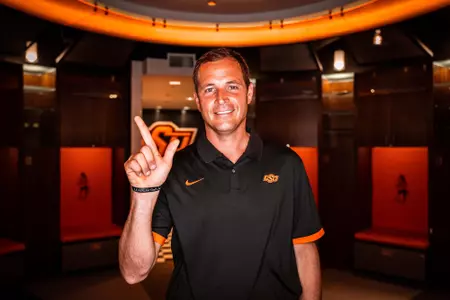
OSU Job Homecoming For Dustin Taylor
August 05, 2021 | Cowboy Tennis
For men's tennis coach Dustin Taylor, joining the staff at Oklahoma State is a sort of homecoming.
Taylor, who was appointed as head coach in June 2021, once played tennis for the University of Tulsa, where he garnered All-America honors and reached the NCAA quarterfinals. It was also in Tulsa where he met his wife, Jennie, and the two grew to love Oklahoma.
After graduating, he became a coach with the United States Tennis Association, where he developed players such as Steve Johnson and Denis Kudla.
"That's kind of always been my niche, is taking players from three or four hundred in the world and trying to get them into the Top 100 or 75. I've been fortunate to do that with a number of guys," Taylor said.
Additionally, from 2014 to 2017, he served as the associate head coach at the University of Virginia, where he oversaw three consecutive NCAA Championships.
But when the chance arose to return to Oklahoma, both Taylor and his wife were drawn to the prospect.
"We always loved our time at TU, we loved the people of Oklahoma, and we always said, if an opportunity presented itself to come back to the state, we would certainly explore it," Taylor said. "To be back in the state of Oklahoma is certainly special; there's no doubt that this was all meant to be, being here in Stillwater, for my family and I."
Besides his history in the state, other aspects that drew Taylor to Oklahoma State included the facilities and the people he'd be surrounded by.
"Obviously, facilities speak for themselves," Taylor said, referring in part to the state-of-the-art Greenwood Tennis Center, a $20 million-dollar complex completed in 2014. "They've put so much money and resources into not only the facilities, but also the staff. You look at the coaches, and you look at the strength and conditioning staff, and you look at all the resources that are available to the student athletes, and it's pretty remarkable."
"To put together that sort of staff and resources to provide to the players, that's really what it's about. It's about putting together a bunch of spokes in a wheel and giving these players the best opportunity to maximize as people and as players."
Taylor said that he was impressed by not only the prowess of his fellow coaches, but also their welcoming attitudes.
"Pretty much every coach in the entire athletic department has reached out, stopped by the office to introduce themselves and shared time with me. It's a family atmosphere that I've never really experienced before."
One such coach is OSU Director of Tennis and women's tennis head coach Chris Young. In his 11 seasons at Oklahoma State, Young has led the Cowgirls to eight NCAA tournaments, including four appearances in the Sweet Sixteen and an appearance in the NCAA Championship.
"He's one of the best coaches in the country," Taylor said. "I was always pretty drawn to Chris and had a lot of respect for him and his program."
Taylor intends to find similar success in his own program. In order to do so, one of his biggest priorities is to install a culture based around positive mentalities.
"Hard work is at the bottom of everything. If you don't work hard, then it doesn't matter how much talent you have––in today's world, you're just not going to go very far. And then at the end of the day, really be resilient," Taylor said. "There's a ton of adversity that everybody goes through in their life. So if they can be resilient and do it with grace, they're probably going to end up being pretty good people and pretty good players."
Additionally, Taylor said that during his time coaching professional athletes for U.S. Tennis, a trait he consistently noticed across the best players was gratitude.
"The top players in the world, they really are grateful for the opportunities and the relationships that they have and for what tennis has done for them throughout their life." Taylor said that working with those athletes taught him the importance of gratitude in being "a consistent human being" both on and off the court.
"I certainly think that it can be taught, it can be preached within a culture," Taylor said, and while he emphasized the importance of holding his players accountable to those values, he said teaching through example is just as important.
"That's our responsibility as leaders. You've got to walk the walk. If you're going to talk about being grateful, if you're going to talk about having a growth mindset, if you're going to talk about being consistent day in and day out with your attitude... you'd better showcase that yourself."
According to Taylor, a strong mentality is the foundation for winning. He aims to teach his players how to "manage success" with humility, grace and respect, features he attributes to the University of Virginia's accomplishments during his time there. "I think all those characteristics can be preached and ingrained, but we can certainly all lose them at times, for sure. So that's why you need to surround yourself with the right people," Taylor said.
As for the part of his job that he's most excited about––aside from winning––Taylor's attention remains on the people he's surrounded by, especially as he fosters bonds with his athletes. "In the past, the players have been a huge part of our family: they've known our kids, they've known our house, they've spent a lot of time with myself and our family off the court," Taylor said. "Life's about experiences and relationships, and I'm just really excited to develop these relationships with our players, with the athletic department, with the community, and with my staff."
For someone who holds gratitude so dear, Taylor exemplifies it in his recognition of the opportunity that lies ahead in Stillwater.
"To be coaching here was certainly a little bit of destiny," he said. "I'm really excited to get to work."
Taylor, who was appointed as head coach in June 2021, once played tennis for the University of Tulsa, where he garnered All-America honors and reached the NCAA quarterfinals. It was also in Tulsa where he met his wife, Jennie, and the two grew to love Oklahoma.
After graduating, he became a coach with the United States Tennis Association, where he developed players such as Steve Johnson and Denis Kudla.
"That's kind of always been my niche, is taking players from three or four hundred in the world and trying to get them into the Top 100 or 75. I've been fortunate to do that with a number of guys," Taylor said.
Additionally, from 2014 to 2017, he served as the associate head coach at the University of Virginia, where he oversaw three consecutive NCAA Championships.
But when the chance arose to return to Oklahoma, both Taylor and his wife were drawn to the prospect.
"We always loved our time at TU, we loved the people of Oklahoma, and we always said, if an opportunity presented itself to come back to the state, we would certainly explore it," Taylor said. "To be back in the state of Oklahoma is certainly special; there's no doubt that this was all meant to be, being here in Stillwater, for my family and I."
Besides his history in the state, other aspects that drew Taylor to Oklahoma State included the facilities and the people he'd be surrounded by.
"Obviously, facilities speak for themselves," Taylor said, referring in part to the state-of-the-art Greenwood Tennis Center, a $20 million-dollar complex completed in 2014. "They've put so much money and resources into not only the facilities, but also the staff. You look at the coaches, and you look at the strength and conditioning staff, and you look at all the resources that are available to the student athletes, and it's pretty remarkable."
"To put together that sort of staff and resources to provide to the players, that's really what it's about. It's about putting together a bunch of spokes in a wheel and giving these players the best opportunity to maximize as people and as players."
Taylor said that he was impressed by not only the prowess of his fellow coaches, but also their welcoming attitudes.
"Pretty much every coach in the entire athletic department has reached out, stopped by the office to introduce themselves and shared time with me. It's a family atmosphere that I've never really experienced before."
One such coach is OSU Director of Tennis and women's tennis head coach Chris Young. In his 11 seasons at Oklahoma State, Young has led the Cowgirls to eight NCAA tournaments, including four appearances in the Sweet Sixteen and an appearance in the NCAA Championship.
"He's one of the best coaches in the country," Taylor said. "I was always pretty drawn to Chris and had a lot of respect for him and his program."
Taylor intends to find similar success in his own program. In order to do so, one of his biggest priorities is to install a culture based around positive mentalities.
"Hard work is at the bottom of everything. If you don't work hard, then it doesn't matter how much talent you have––in today's world, you're just not going to go very far. And then at the end of the day, really be resilient," Taylor said. "There's a ton of adversity that everybody goes through in their life. So if they can be resilient and do it with grace, they're probably going to end up being pretty good people and pretty good players."
Additionally, Taylor said that during his time coaching professional athletes for U.S. Tennis, a trait he consistently noticed across the best players was gratitude.
"The top players in the world, they really are grateful for the opportunities and the relationships that they have and for what tennis has done for them throughout their life." Taylor said that working with those athletes taught him the importance of gratitude in being "a consistent human being" both on and off the court.
"I certainly think that it can be taught, it can be preached within a culture," Taylor said, and while he emphasized the importance of holding his players accountable to those values, he said teaching through example is just as important.
"That's our responsibility as leaders. You've got to walk the walk. If you're going to talk about being grateful, if you're going to talk about having a growth mindset, if you're going to talk about being consistent day in and day out with your attitude... you'd better showcase that yourself."
According to Taylor, a strong mentality is the foundation for winning. He aims to teach his players how to "manage success" with humility, grace and respect, features he attributes to the University of Virginia's accomplishments during his time there. "I think all those characteristics can be preached and ingrained, but we can certainly all lose them at times, for sure. So that's why you need to surround yourself with the right people," Taylor said.
As for the part of his job that he's most excited about––aside from winning––Taylor's attention remains on the people he's surrounded by, especially as he fosters bonds with his athletes. "In the past, the players have been a huge part of our family: they've known our kids, they've known our house, they've spent a lot of time with myself and our family off the court," Taylor said. "Life's about experiences and relationships, and I'm just really excited to develop these relationships with our players, with the athletic department, with the community, and with my staff."
For someone who holds gratitude so dear, Taylor exemplifies it in his recognition of the opportunity that lies ahead in Stillwater.
"To be coaching here was certainly a little bit of destiny," he said. "I'm really excited to get to work."

Saturday, August 29
Wednesday, August 26
Thursday, August 20
Monday, August 17