Oklahoma State University Athletics
1997-98 Season Outlook
July 25, 2003 | Cowboy Basketball
The 1996-97 Oklahoma State men's basketball team was one of the youngest in recent memory, with five incoming freshmen and a transfer joining the roster. The 1997-98 team will be even younger.
Two of last year's freshmen redshirts, and the Cowboys have added a freshman and two sophomore transfers to the mix. Add it all up, and among its scholarship players, OSU has two seniors, one junior -- and eight players with experience of one year or less at the collegiate level. "I think we're still a young basketball team," says Cowboy head coach Eddie Sutton. "We're not experienced; we lost three pretty good basketball players in Chianti Roberts, Marlon Dorsey and Maurice Robinson. But we're still optimistic about the upcoming season. One of our two seniors, Brett Robisch, made a lot of progress last season."
Robisch, a 6-11 forward/center who transferred from Illinois and began his OSU career five games into last season, was named to the Big 12 All-Newcomer Team after making tremendous strides during the second half of the season. After averaging 5.5 points and 4.5 in his first 10 contests, Robisch averaged 12.4 ppg and 7.5 rpg over the final 17 games of the year. He shined in the last two regular-season games of the year, scoring a career-high 24 points at Nebraska and leading OSU in points (16), rebounds (five) and assists (a career-high six) in the home finale against Iowa State.
The Cowboys' only other senior is 6-3 guard Chad Alexander. Alexander currently ranks ninth all-time at OSU in three-point field goal percentage and played particularly well early in his junior season, averaging 11.2 through one five-game stretch in December. "Chad's obviously going to play quite a bit," says Sutton. "He's the last remaining player from our 1995 Final Four team. His experience, along with Brett's, will be important to us."
OSU's only junior is Adrian Peterson, a 6-4 guard who led the Cowboys in scoring as a sophomore. Twice named to the honorable mention all-conference team, Peterson had an up-and-down season with several highs -- he scored over 20 points six times -- but a few lows as well; he had four games with two or fewer points.
An outstanding shooter, Peterson needs just 47 points to rank among the Cowboys' top 30 career scorers despite having played only two seasons so far. His development will be key for the Cowboys this season. "I think Adrian Peterson has a chance to elevate his game to become one of the premier off-guards in the Big 12," says Sutton. "Certainly, he's shown that he's capable of it, but in doing that he can't have the inconsistent games like he had through the conference season, where he'd score 25 one night and get shut out the next. He's got to be very consistent and become one of the leaders of this team. That's got to be an everyday thing."
Peterson is the top returner at the Cowboys' most talent-filled area on the floor: the backcourt. He and Alexander are two of five guards who could see extensive playing time.
One of those players is sophomore Joe Adkins, a highly touted player who came to life in OSU's last two home games last season. He scored a career-high 12 points, with nine of those coming in the final five minutes, to lead the Cowboys over Iowa State, and he tallied a career-high 19 in the NIT victory against Tulane. "We may try to play three guards at times," says Sutton. "Some of our best teams had three guards, and Arizona won the national championship playing three guards. I think if you do that, Joe is still more comfortable at the off-guard position, but I think he made some progress last year at the point. But the way we play, except in transition and initiating the offense, the guards are all the same anyway."
One key member of last season's recruiting class who sat out with an early-season broken arm is Estell Laster, a 6-2 guard who redshirted his first year at OSU. Laster showed promise in his first two games, one of which was a 10-point performance in an exhibition, but he broke his arm in OSU's third game of the year and had to sit out the season. "Estell is fully healed, and I'd be very surprised if he doesn't play a lot this year," says Sutton. "In fact, I think he'd have played a lot last year. He's one of the best defenders on the ball that we have, and a guy that's capable of scoring in bunches. There'll be a lot of competition on the perimeter."
Throw in transfer Doug Gottlieb, and it's easy to see why Sutton expects the fight for backcourt playing time to be hot. Gottlieb, who begins his OSU career as a sophomore, played as a freshman at Notre Dame in 1995-96. He started 23 games as a freshman point guard and led the team in assists with a 154, a total that would rank among OSU's top five all-time. "I think Doug will be a real asset; he'll challenge for a starting position," says Sutton. "He probably has the moxie and ability to be a good point guard, and his strength is his ability to pass the ball. He can score, but he's the type of player who probably looks to dish it off before he looks to score."
Despite a domination of youth, the perimeter appears to be OSU's strong suit heading into the 1997-98 season. "I would think that the people we have returning will play with the experience that comes from having a year under their belts," says Sutton. "I think we've got good perimeter players. The question marks are probably more the depth up front. Alex Webber is a key question, whether he can be fully recovered, and there's no reason to think he won't be."
Webber, the most consistent OSU freshman a year ago, missed the last half of the season after undergoing surgery to repair a ruptured disk. The leading scorer among Cowboy freshmen at the time of his injury, Webber has begun playing pickup games with his teammates and appears to be well on his way to full recovery. "Alex has been given the green light to go full speed, but he needs to work on his conditioning, and he's working with a physical therapist," says Sutton. "It's very important that he get healthy, because he's going to play a lot."
Though the Cowboys have three returning frontcourt players standing 6-10 or taller and four guards coming back who are 6-4 and below, just one player stands between them on the height chart: 6-6 Desmond Mason.
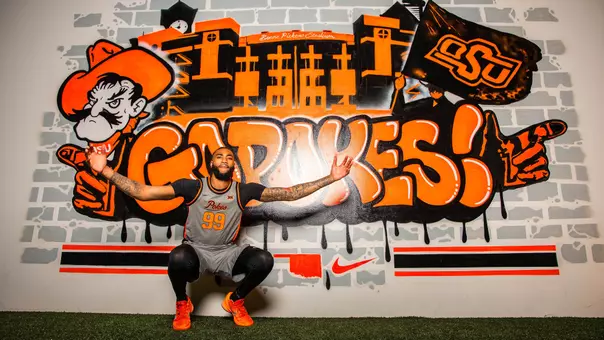
Mason, the preseason Big 12 Freshman of the Year, led OSU's freshmen in scoring and rebounding last season. An outstanding leaper, he made himself an instant celebrity at OSU when he shattered a backboard with a pregame dunk during the annual preseason Basketball Bash. "Desmond ought to be one of the best defenders we've had if he takes the challenge," says Sutton. "He's got to be able to guard a lot of guys around 6-3 or 6-7, and he should also be able to be one of the best offensive rebounders in the league if he puts his mind to it, as much athletic ability as he has."
Joining Mason, Brett Robisch and Webber in the frontcourt is Brett's younger brother, Scott. The younger Robisch played in five games last year but was hampered by tendinitis and broke his hand before the Colorado game. He received a medical redshirt. "I think Scott's going to play some," says Sutton. "He's a tough kid; he just needs to be a little stronger. As he gets some experience, he'll help us more and more."
Joining the backcourt roster are 6-9 sophomore transfer Brian Montonati and 6-7 freshman Michael Johnson. "Brian is a bit like Scott in that he's got to get stronger," says Sutton. "He's skilled; it's just a matter of gaining some experience. He has quick feet, and he passes the ball well for a guy his size and shoots it well. He's been able to play inside and outside in junior college, but he'll have to get stronger to play in the low post with our competition. "Mike Johnson is a good player. It's a tough jump from high school basketball to the Big 12, but he's tough. He's an intelligent player, and I think he's got a tremendous break in that we are some thin up front. With this ballclub, he's going to play a lot."
Last season was a bizarre one at times for the Cowboys and was marked by lack of depth: Five players suffered broken bones in addition to Webber's back surgery and the mid-season departure of forward Jason Skaer. But the Cowboys were able to salvage 17 wins and an NIT appearance from that difficulty. "I think the biggest thing last year was the injuries," says Sutton. "You have to be pleased at the display of courage that allowed us to win as many as we did. We just pray that we keep everybody healthy this year."
One disturbing feature of the 1996-97 team, though, was that its defensive output did not appear to match OSU's recent outstanding tradition. In fact, the Cowboys remarkably ranked 12th in the league in field goal percentage defense. "I think the defense has to step up and be a lot better than it was," says Sutton. "I think we were very inconsistent; there were times when we played very good defense, but overall it was disappointing. I think the rule change (reinstatement of the five-second closely guarded rule) will help with our philosophy defensively. We'll be able to get back to the overplaying and pressure man with the five-second count."
The Cowboys also expect to continue their tradition of home-court dominance. OSU was 14-2 at home last season and has won 70 consecutive non-conference home games, the longest such streak in the country. And the Cowboys, who played the nation's sixth-toughest schedule last season, look forward to the second year of the Big 12 Conference. "The league will be as strong as ever," says Sutton. "Several of the teams will be better, and Kansas will probably be the No. 1 team in the country again. I think it's going to be one of the top three or four conferences in college basketball."