Oklahoma State University Athletics
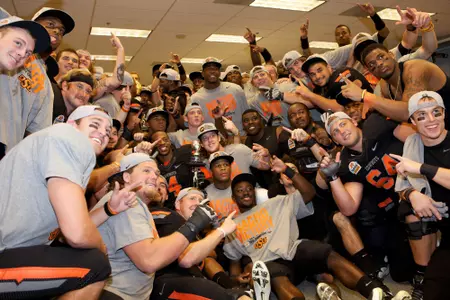
Photo by: OstatePhoto
2011 Cowboys to be Honored on Saturday: A Look Back at the 2011 Season
September 28, 2021 | Cowboy Football
It's been 10 years since one of the greatest seasons in the history of Oklahoma State football. The 2011 Cowboys set a new height for the program and put OSU on the national map in college football to stay. On Saturday, members of the 2011 team will be honored during Oklahoma State's top-25 showdown against No. 21 Baylor.
In honor of alumni weekend approaching, here's a look back at the 2011 season:
A 12-1 record, the school's first Big 12 championship, a 44-10 victory over Bedlam Series rival Oklahoma and a win in the Tostitos Fiesta Bowl were the highlights of a season in which the Cowboys were a legitimate national championship contender.
OSU finished third in the final polls and was 0.0086 points away in the final BCS standings from playing in the BCS national championship game – representing the narrowest margin in BCS history by which a team was left out of the title game.
The Cowboys notched a school-record five wins over ranked opponents, highlighted by a 41-38 overtime triumph over No. 4 Stanford in the Fiesta Bowl, a come-from-behind 30-29 win at No. 8 Texas A&M and the 44-10 thrashing of No. 13 Oklahoma, but a loss at unranked Iowa State late in the season is what kept the Cowboys out of the BCS championship game.
Head coach Mike Gundy was recognized as the national coach of the year by winning the Eddie Robinson Award given by the Football Writers Association of America and the Paul "Bear" Bryant College Coach of the Year award, in addition to being tabbed as the nation's top coach by American Football Monthly Magazine.
For the second straight season, Justin Blackmon earned the Biletnikoff Award presented to the nation's best wide receiver and he headlined a crop of six OSU players to secure All-America honors and 12 Cowboys to earn All-Big 12 recognition.
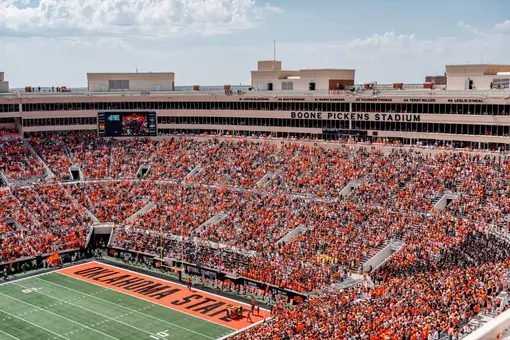
Fans came out at a record-setting level to watch perhaps the nation's most exciting team, as OSU set a school record at the time by selling 48,714 season tickets in 60,000-seat Boone Pickens Stadium.
The 2011 Cowboys were ranked among the nation's elite in several statistical categories, but were primarily known for having a nearly-unstoppable offense. OSU ranked second nationally in both scoring offense and passing offense and were third in total offense.
Perhaps the biggest question mark entering the season was how new offensive coordinator Todd Monken would fare guiding the already-potent Oklahoma State offense that shredded defenses in 2010 and returned almost all of its key players.
Monken came to Stillwater after spending the previous four seasons as receivers coach for the Jacksonville Jaguars. He hadn't been in the college game since spending the 2005-06 seasons at LSU.
Monken silenced the doubters as the 2011 Pokes set new single-season records for points scored, touchdowns scored, first downs, pass attempts, pass completions, passing yards, completion percentage, touchdown passes, total offense, yards per play and successful third-down conversions. Led by Monken's orchestration in the booth and quarterback Brandon Weeden's mastery on the field, the Cowboys of 2011 registered six of the top seven single-game passing marks in school history at the time.
Weeden and Blackmon gained notoriety as the nation's most feared pass-catch combination, and while the attention they received was all justified, there were several other key components that propelled the Oklahoma State offense to unprecedented heights in 2011.
The offensive line boasted a pair of All-Americans in center Grant Garner and Levy Adcock and ranked among the national leaders in fewest sacks allowed. Led by a pair of sophomore running backs in Joseph Randle and Jeremy Smith, the Cowboys averaged a very productive 5.3 yards per rush and put a great deal of stress on opposing defensive coordinators by forcing them to either choose between trying to slow one of the nation's elite passing attacks at the expense of being gouged by a more-than-capable running attack, or trying to stop the run game at the expense of being torched by a devastating passing game.
The decisions didn't get any easier for opposing defenses near the goal line, either. The Weeden-to-Blackmon connection in the back corner of the end zone was a near-automatic six points and commanded the utmost respect from opposing teams, but at the same time, Randle ranked fourth in the nation with 24 rushing touchdowns – a total that was higher than 79 teams registered in 2011.
Opponents were forced to pick their poison because OSU could get in the end zone with consistency no matter what the other team attempted to take away. While the OSU offense overwhelmed foe after foe, the most difficult storyline for outsiders to reconcile was the Cowboy defense. Out of 120 teams in the nation, Oklahoma State ranked 107th in total defense. Contrary to the pre-existing notion of what winning football looks like, the Pokes were 90th nationally against the run and 107th against the pass, yet still won games by an average margin of 22 points per game.
So how did they do it? By forcing turnovers and stuffing teams in the red zone.
While critics called attention to the substantial yardage, first down totals and time of possession numbers put up against the Cowboy defense, what they could have focused on is the fact that OSU led the Big 12 in scoring defense in conference games, led the nation in turnovers forced, led the Big 12 and ranked 12th nationally in red zone defense and was second in the Big 12 and 20th nationally in pass efficiency defense.
Often times, the Cowboy defense was a victim of the Cowboy offense's success and its quick-strike nature. The Oklahoma State offense led the nation with 48 scoring drives that took less than two minutes off the clock. Of those 48 drives, 21 took less than one minute off the clock. OSU had 40 offensive scoring drives of five plays or less. All of that resulted in the defense not getting enough rest while the offense lit up the stadium scoreboard each week.
A typical Oklahoma State game in 2011 looked like this: the Cowboys roar out to an insurmountable lead, then allow significant amounts of points and yardage in the second half when the games were already well out of reach, thus inflating opponents' stats and making the OSU defense look statistically worse than it was.
The examples were many. OSU led Louisiana, 31-3 and won the game 61-34. OSU led Tulsa, 45-6 and won the game, 59-33. OSU led Kansas, 56-7 at the half and won the game, 70-28. OSU led Baylor, 42-0 and won the game 59-24.
While steamrolling opponents was the norm for Oklahoma State in 2011, the final highlight of the season came when Quinn Sharp kicked a field goal in overtime to push the Cowboys to a thrilling 41-38 overtime win over No. 4 Stanford at the Fiesta Bowl. A game-winning field goal and hero's exit was appropriate for Sharp, who could easily make an argument for being the best special teams player in the country in 2011.
Sharp handled all the kickoffs, placements and punting for OSU and excelled in each facet of the game. For the third straight season, he led the nation in touchbacks on kickoffs with 61 - an overwhelming 21 touchbacks more than the second-place kicker. He also led the nation in kicker scoring and was third in punting average.
For his efforts, Sharp was named Big 12 Special Teams Player of the Year and was the first-team All-America kicker by the Football Writers Association of America. After being the FWAA's first-team All-America punter the previous season, Sharp became only the third player in the FWAA All-America team's 68- year history to earn first-team All-America honors at two different positions.
The unique success of Sharp on special teams meshed with a thrilling offense and opportunistic defense made 2011 stand alone as the greatest season in Oklahoma State history.
In honor of alumni weekend approaching, here's a look back at the 2011 season:
A 12-1 record, the school's first Big 12 championship, a 44-10 victory over Bedlam Series rival Oklahoma and a win in the Tostitos Fiesta Bowl were the highlights of a season in which the Cowboys were a legitimate national championship contender.
OSU finished third in the final polls and was 0.0086 points away in the final BCS standings from playing in the BCS national championship game – representing the narrowest margin in BCS history by which a team was left out of the title game.
The Cowboys notched a school-record five wins over ranked opponents, highlighted by a 41-38 overtime triumph over No. 4 Stanford in the Fiesta Bowl, a come-from-behind 30-29 win at No. 8 Texas A&M and the 44-10 thrashing of No. 13 Oklahoma, but a loss at unranked Iowa State late in the season is what kept the Cowboys out of the BCS championship game.
Head coach Mike Gundy was recognized as the national coach of the year by winning the Eddie Robinson Award given by the Football Writers Association of America and the Paul "Bear" Bryant College Coach of the Year award, in addition to being tabbed as the nation's top coach by American Football Monthly Magazine.
For the second straight season, Justin Blackmon earned the Biletnikoff Award presented to the nation's best wide receiver and he headlined a crop of six OSU players to secure All-America honors and 12 Cowboys to earn All-Big 12 recognition.
Fans came out at a record-setting level to watch perhaps the nation's most exciting team, as OSU set a school record at the time by selling 48,714 season tickets in 60,000-seat Boone Pickens Stadium.
The 2011 Cowboys were ranked among the nation's elite in several statistical categories, but were primarily known for having a nearly-unstoppable offense. OSU ranked second nationally in both scoring offense and passing offense and were third in total offense.
Perhaps the biggest question mark entering the season was how new offensive coordinator Todd Monken would fare guiding the already-potent Oklahoma State offense that shredded defenses in 2010 and returned almost all of its key players.
Monken came to Stillwater after spending the previous four seasons as receivers coach for the Jacksonville Jaguars. He hadn't been in the college game since spending the 2005-06 seasons at LSU.
Monken silenced the doubters as the 2011 Pokes set new single-season records for points scored, touchdowns scored, first downs, pass attempts, pass completions, passing yards, completion percentage, touchdown passes, total offense, yards per play and successful third-down conversions. Led by Monken's orchestration in the booth and quarterback Brandon Weeden's mastery on the field, the Cowboys of 2011 registered six of the top seven single-game passing marks in school history at the time.
Weeden and Blackmon gained notoriety as the nation's most feared pass-catch combination, and while the attention they received was all justified, there were several other key components that propelled the Oklahoma State offense to unprecedented heights in 2011.
The offensive line boasted a pair of All-Americans in center Grant Garner and Levy Adcock and ranked among the national leaders in fewest sacks allowed. Led by a pair of sophomore running backs in Joseph Randle and Jeremy Smith, the Cowboys averaged a very productive 5.3 yards per rush and put a great deal of stress on opposing defensive coordinators by forcing them to either choose between trying to slow one of the nation's elite passing attacks at the expense of being gouged by a more-than-capable running attack, or trying to stop the run game at the expense of being torched by a devastating passing game.
The decisions didn't get any easier for opposing defenses near the goal line, either. The Weeden-to-Blackmon connection in the back corner of the end zone was a near-automatic six points and commanded the utmost respect from opposing teams, but at the same time, Randle ranked fourth in the nation with 24 rushing touchdowns – a total that was higher than 79 teams registered in 2011.
Opponents were forced to pick their poison because OSU could get in the end zone with consistency no matter what the other team attempted to take away. While the OSU offense overwhelmed foe after foe, the most difficult storyline for outsiders to reconcile was the Cowboy defense. Out of 120 teams in the nation, Oklahoma State ranked 107th in total defense. Contrary to the pre-existing notion of what winning football looks like, the Pokes were 90th nationally against the run and 107th against the pass, yet still won games by an average margin of 22 points per game.
So how did they do it? By forcing turnovers and stuffing teams in the red zone.
While critics called attention to the substantial yardage, first down totals and time of possession numbers put up against the Cowboy defense, what they could have focused on is the fact that OSU led the Big 12 in scoring defense in conference games, led the nation in turnovers forced, led the Big 12 and ranked 12th nationally in red zone defense and was second in the Big 12 and 20th nationally in pass efficiency defense.
Often times, the Cowboy defense was a victim of the Cowboy offense's success and its quick-strike nature. The Oklahoma State offense led the nation with 48 scoring drives that took less than two minutes off the clock. Of those 48 drives, 21 took less than one minute off the clock. OSU had 40 offensive scoring drives of five plays or less. All of that resulted in the defense not getting enough rest while the offense lit up the stadium scoreboard each week.
A typical Oklahoma State game in 2011 looked like this: the Cowboys roar out to an insurmountable lead, then allow significant amounts of points and yardage in the second half when the games were already well out of reach, thus inflating opponents' stats and making the OSU defense look statistically worse than it was.
The examples were many. OSU led Louisiana, 31-3 and won the game 61-34. OSU led Tulsa, 45-6 and won the game, 59-33. OSU led Kansas, 56-7 at the half and won the game, 70-28. OSU led Baylor, 42-0 and won the game 59-24.
While steamrolling opponents was the norm for Oklahoma State in 2011, the final highlight of the season came when Quinn Sharp kicked a field goal in overtime to push the Cowboys to a thrilling 41-38 overtime win over No. 4 Stanford at the Fiesta Bowl. A game-winning field goal and hero's exit was appropriate for Sharp, who could easily make an argument for being the best special teams player in the country in 2011.
Sharp handled all the kickoffs, placements and punting for OSU and excelled in each facet of the game. For the third straight season, he led the nation in touchbacks on kickoffs with 61 - an overwhelming 21 touchbacks more than the second-place kicker. He also led the nation in kicker scoring and was third in punting average.
For his efforts, Sharp was named Big 12 Special Teams Player of the Year and was the first-team All-America kicker by the Football Writers Association of America. After being the FWAA's first-team All-America punter the previous season, Sharp became only the third player in the FWAA All-America team's 68- year history to earn first-team All-America honors at two different positions.
The unique success of Sharp on special teams meshed with a thrilling offense and opportunistic defense made 2011 stand alone as the greatest season in Oklahoma State history.
Friday, September 18
Thursday, September 17
Thursday, September 17
Wednesday, September 16