Oklahoma State University Athletics
The Evolution of Collegiate Equestrian
April 14, 2019 | Cowgirl Equestrian
By Matt McClain, OSU Athletics Communications
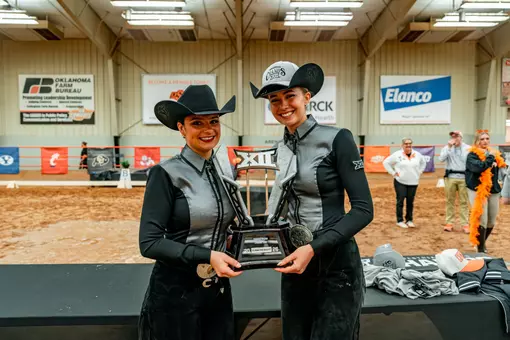
There is nothing ordinary about collegiate equestrian.
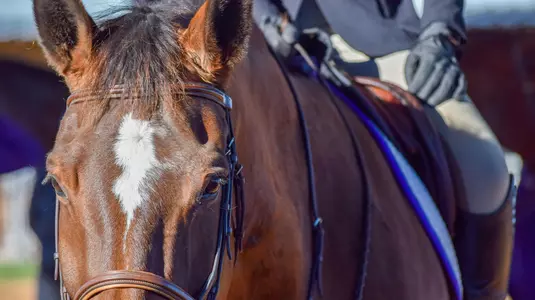
Equipment does not come in the form of any bat or ball or set of pads. The equipment is a living animal: A horse.
Time is not only dedicated to those horses, but also to the student-athletes who ride them in competitions.
Larry Sanchez, the coach at Oklahoma State University, has balanced his time for the horses and athletes for 20 years.
Sanchez said he likes to believe all of his time is given to athletes and horses, but he has received help in maintaining his horses.
"We never have a day off from horse maintenance and care," Sanchez said. "It's always on my mind and always on my heart. If there's a storm coming through or if the weather drops below freezing or if there's an ice storm, you can't help but think about what you need to do to make sure the horses are good."
Sanchez said he also gets a lot of help from his assistant coaches.
Jenna Blumer is one of Sanchez's assistant coaches and has been a coach at OSU for four years; she rode for the Cowgirls from 2010-14 and was a three-time All-American.
Blumer coaches the Cowgirls' reining team but also spends a lot of time maintaining the horses.
"It's all a team effort," Blumer said. "There's a lot of behind-the-scenes stuff. I coach the reiners, but we work together to take care of horse and make sure they're the weight they need to be (and those sorts of things). We do a lot of recruiting as well."
These horses often make their way to OSU through donations.
Unlike a traditional monetary donation in collegiate athletics, a lot of gifts to equestrian teams come in the form of horses.
Sanchez said he has had a countless number of horses donated to him in his time at OSU. He also said that about 50-60 percent of the horses donated are from families or acquaintances of team members.
"When we first started building the program, the donations weren't coming in as much, so we had to buy some horses," Sanchez said. "For the past 13-14 years, we haven't had to buy any horses."
Kristi Wiggins is one of the Cowgirls whose family has donated a horse. Wiggins' family donated Hannah, one of at least 20 horses in OSU's stables.
Wiggins said it is a special feeling to pass a horse she has a personal connection with.
"I get to go down there and walk past her and she's superhappy," Wiggins said. "Even though she has 15 other people that work with her, she still sees me and knows I'm the one that got her here."
Horse donation is a common practice in the collegiate equestrian realm.
Baylor coach Casie Maxwell said her program also brings donated horses.
The horses go through a lengthy process that includes a trial period to make sure they will be a fit in the events the programs need them to compete in.
Maxwell said the donations are vital.
"That's what keeps the program running," Maxwell said. "That's our equipment. Football needs pads and a ball to play. We need horses to compete. We're so lucky for the horses we get."
The equestrian programs are not the only benefactors of the donations.
Donors can receive a tax write-off for their donations. The horses go through an appraisal process to determine how much they're worth and based on that number, a tax write-off is granted.
Maxwell said the write-offs can be $500-$100,000.
Although horses are donated often, a more recent and significant donation was made to benefit the OSU equestrian program.
A covered arena was constructed and opened this season.
The covered arena is the most recent addition to OSU's equestrian competition arenas. The Cowgirls have called Totusek Arena home since the inception of the program in 1999.
Sanchez said he had worked to get a covered arena for 18 years, but the bulk of the work was done in the past 1 1/2 years.
"It's something we've needed for a long time," Sanchez said. "I've had the vision for a very long time."
Sanchez said one donor made a large gift, and that led to a matching gift. He said the lead donors will remain anonymous until there is an official unveiling of the arena.
The covered arena is one of the ways OSU has seen evolution of the sport, but Sanchez and Maxwell agree collegiate equestrian is growing.
There are 25 schools that are members of the National Collegiate Equestrian Association. Division I is responsible for 16 of those teams.
The NCAA, the governing body for collegiate athletics, does not recognize equestrian as a championship sport, for there are fewer than 40 teams. Equestrian is still considered an emerging sport by the NCAA because of its low number of schools that support equestrian.
There have been two major changes in collegiate equestrian.
Despite the size of the sport, Sanchez said collegiate equestrian has come a long way since he built the OSU program in 1999.
The first comes in the form of recruiting athletes. High school equestrian athletes typically train with a personal coach. Sanchez said a lot of coaches were worried their athletes would stop training with them to instead go to college.
"They may have a girl sell her horse and go on to college," Sanchez said. "For every one of those girls they lost, there were 15-20 girls at a young age that wanted to eventually go to college. When those girls find out a trainer got a girl to the collegiate level, they want to be a part of that."
The other major change has come in the competition format.
Sanchez said competitions used to be divided by skill level. He said there were opportunities for riders who were new to the sport to compete collegiately. The format has since been condensed into one skill level, so the emphasis on recruiting elite level athletes is higher.
Sanchez and Maxwell have to do a lot of recruiting because their roster sizes are large.
OSU is required to carry 50 members on its roster, which is an initiative Sanchez said comes from the athletic department.
Sanchez said the roster size is meant to help OSU comply with Title IX requirements.
The number is oddly large at first glance because teams can only have 20 athletes compete at maximum across four events.
Based on a school's enrollment and its ratio of male to female students, that school's athletic program is required to have a similar ratio in its student-athlete population.
OSU has two sports, football and wrestling, with large male roster that have no offsetting female sport.
Equestrian is one of the sports that helps offset those rosters. Women's soccer is the other.
Sanchez said he does not look at the situation as his team is only there for its large roster.
"I look at it as: 'We are so fortunate to be here because of (OSU) Athletics,'" Sanchez said. "I am able to provide so much to my riders that I wouldn't be able to without the help of (OSU) Athletics."
With so many walk-ons on the roster and not enough spots to compete, it might be considered easy for athletes to not be involved, but that isn't the case at OSU.
Hannah Lovrien, a freshman reining rider, said walk-ons do a lot whether it is sweeping the barn or warming up the horses before competition.
"It takes every single one," Lovrien said. "Everyone coming together and being one and cheering for each other is so good because it can take us so far."
Walk-ons' efforts are not only seen by teammates, but the coaches also see it.
Blumer said walk-ons do the same amount of chores around the barns as the athletes who are competing on meet day.
"There isn't really a difference between the walk-ons and the starters," Blumer said. "We treat them all the same in terms of the work we expect them to do."
A similar initiative is given to the Baylor equestrian team. The Bears are required to carry 65 members.
Maxwell said it is sometimes a challenge to have a large roster, but she said her team has a great atmosphere.
"When they're all going through workouts and going through the ups and downs together, they all have each other's backs," Maxwell said. "It's not like anything they've had before because they go 18 years competing as an individual and then they get to college and compete on a team."
Sanchez and Maxwell said they see the sport continuing to grow.
The number of teams is going to increase, for Sanchez said there are a number of Division I schools that are looking to add the sport. He said he could not specify which teams are adding the sport until they make that information public.
With a number of Division I and II schools building programs and about 15 Division III teams, which the NCAA does not recognize, equestrian will soon be an NCAA championship sport.
Sanchez said he thinks it could happen in one year, but he does not think that is a likely outcome because of slow-moving NCAA legislation that would recognize those 15 Division III schools.
"I think once we get NCAA championship status, we will see a lot of changes in our sport," Sanchez said. "The stakes will be a lot higher."