Oklahoma State University Athletics
Officially Speaking
September 26, 2013 | General

| Kent Houck is like most OSU athletics
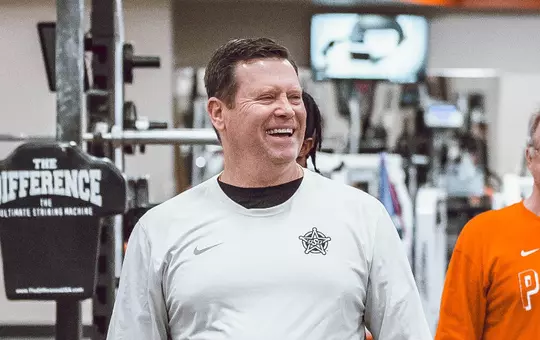
donors. He's a proud Oklahoma State alumnus. He's a successful businessman. He gives back to the university, and he loves OSU athletics. In fact, he and his wife, Barbara, have season tickets to almost everything, and they attend as many games and matches as they can. But Houck wasn't always in the stands. He was on the field. He used to be an official in the Big 8. You know, those guys in the striped shirts football fans either love or hate, depending on the call. Houck officiated 17 bowl games, two of which were for national championships. |
 |
| He didn't grow up dreaming of becoming an
official. He grew up playing sports. Houck went to Oklahoma Christian
University on a baseball scholarship, and would have stayed there if the
university hadn't cancelled the program. "They decided to eliminate their baseball program and concentrate on track and basketball, which they were really strong in during the 1960s" says Houck. "So I came back to OSU and walked on. There were five of us. The OSU coach basically told us, `If you guys were any good, I would've given you a scholarship out of high school.' I understood. He had a full roster." But Houck didn't want to be finished with sports, and struck upon the idea of becoming a baseball umpire. So he visited a friend of his, W.C. "Bill" Taylor, who had officiated a lot of Houck's high school baseball games, and asked him how he could get into "umping." Taylor offered to take Houck under his wing. "He and Pert Butler took me under their wing that spring," says Houck. "I umpired a lot of games with them. Cushing, Perry, Glencoe, Chandler ... Back in those days, the baseball coach at these small schools was usually the head football coach. They started asking me, `Houck, when are you going to ref football? Well, I never really played football. I hadn't given it a thought. They thought I'd be a better football ref because I hadn't played the game, and I'd be watching what I should as a ref and not just watching the game." So the next fall, Butler and Taylor added him to their two-man football crew. Back then (circa 1962), according to Houck, officiating crews only consisted of two men: a referee and an umpire. Houck went to Dupree Sports on the Strip to get his equipment - shirt, pants, shoes, cap, flag and whistle, and was ready to learn the ropes. |
|
| "You just tell us what you see and hustle the football." | |
| His first game was at Pawnee Junior High
School. Taylor and Butler took him through a pre-game warm-up. "Mr. Butler said, `Houck, let me see your flag.' So I showed him my flag. Then Mr. Taylor said, `Now let me see your whistle.' So I gave him my whistle. Then he said, `Now if you do a good job, we'll give them back to you after the game is finished.' They didn't want me to get them in trouble for blowing an inadvertent whistle or throwing a flag when I didn't know what I was doing. `You just tell us what you see and hustle the football.' They put me at head linesman. "That whole season they took me along to every high school game, every junior high game, every B game ... I must've worked 20 or 25 football games with those guys without a whistle or a flag. By the end of the season they said, `Houck, you're going to make a good official.'" Following football season, he began officiating basketball games. He'd
played on the Stillwater High state championship basketball team, so he
was comfortable refereeing the sport. He picked up John Klinger, another
Stillwater businessman, to help. After basketball, he umpired baseball
again. "Instead of having three officials, I got four. John, my basketball partner, was my umpire. Then I got Dick Clark, he was my State Farm agent, and Russell Robins, my barber. The four of us in 1963 formed the first four-man officiating crew in Oklahoma. We'd call the schools around here, and tell them they'd only have to pay for three, and we'd bring the fourth for free. Well, after we worked that season, all the coaches realized that four officials did a much better job than three. So they started hiring four officials." |
|
| He worked high school games with that crew until 1972. In 1965, Kenny Gallagher, commissioner of the Oklahoma Intercollegiate Conference at the time, asked if they wanted to move to college refereeing. So they did that until 1971. Houck was a pilot and had his own airplane, so the OIC sent him all over the state refereeing basketball and football. (He received his pilot's license his sophomore year at OSU, which made getting around to the games much easier.) |
Well, sure, doesn't everybody want to be in the Big 8? |
| In the fall of 1969, he got a phone call from a man named Artie Palk.
"I didn't know Artie," says Houck. "He
said, `I understand you're a certified football official. Do you have a
game tonight?' And that particular Friday night, I hadn't taken a game
because I was serving as youth minister at my church. He said, `my head
official just had an emergency appendectomy. I need someone to go to
Muskogee and work the Tulsa Washington/Muskogee game.' I said I'd be
happy to help. So I drove to Tulsa and got in a car with these three
guys I'd never met - Artie Palk, Bill Blackburn and Gerald Glass - and
then worked the game in Muskogee." |
|
| I would rather work 10 national championships than one NFL game. | |
| "That was a really strong crew. Those six
guys meshed together well. Vance Carlson, I would say, is the greatest
official college has ever known. In fact, when he retired from
officiating, we had a big party for him. Barry Switzer, Tom Osborne and
other big-name coaches were there. He was that well thought of. There's
not been anyone better." "As a crew we worked that many bowl games and two national championships. When you think that there are 10,000 officials in America and most of them never get to work a bowl game, and especially not national championship ... For our crew to get to work two is pretty impressive. Again, I was in the right place at the right time. I would've never met Artie Palk and Bill Blackburn if I hadn't been off that night. "That crew was together for around 20 years. Vance, Artie and I were together until 1988. The Big 8 used to have a rule that you retired at 56. NFL doesn't have one. They relinquished that a little bit, raised it to 58. Vance's last game was the Aloha Bowl in 1984." Houck continued to officiate until 1992, and the 1991 Holiday Bowl was his final bowl game. The NFL called, but he turned them down. He wasn't interested. "In my opinion, the game is still at the collegiate level. I would rather work 10 national championships than one NFL game. If you go to the NFL, they own you lock, stock and barrel," he says. Houck's seen the officiating game change over the years, and fears that it's become too much about the officials themselves, and less about officiating a great game of football. "We felt like it was our responsibility to go out and officiate a game so that no one even knew there were officials on the field, and may the best team win. "If I made a mistake, one of the other guys on the crew would walk by me without looking and say, `Houck, you didn't see what you thought you saw. Pick up your flag.' Our philosophy was a mistake by one was a mistake by all. We were there for the game. Let's hope no one notices we're on the field. There were several times we bailed each other out." |
|
| Houck says he met a lot of great people over the
years, and speaks highly of many of the old Big 8 coaches, such as Tom
Osborne, Switzer, Dan Devine, Jim Stanley and Pat Jones, as well as
Terry Donahue, Pat Dye and Lou Holtz. "I never had a bad experience in the 20 years I officiated," says Houck. "I was not involved in any controversy. I was never in a game decided by any kind of bad calls. I met some wonderful coaches. I consider some of them good friends. I could pick up the phone and call Tom Osborne. Tom and I have always had a great relationship. Switzer and I are very close. He's done a lot of good things for me. He has a great heart. I run summer camps for kids. I have an auction, and Barry's always been willing to autograph anything I needed." |
I never had a bad experience in the 20 years I officiated. |
| Houck also had a good relationship with Joe Paterno. "He was a very
classy individual. I have a hard time hearing some of the things people
have said about him. I think he did what he thought he should do. And
the people above him probably didn't follow through like he would have
wished. He never mistreated his kids. Never cussed them. There are
coaches I would never let my kid play for. "Osborne, Paterno, Holtz ... some of those guys are very classy people. I think Gundy is doing an excellent job. He treats his kids right. He's built a family atmosphere. I know a lot of kids who come here to play. Their parents allow them to come here instead of other places they've been recruited to because Mike has done a good job with his staff and the community to show we're one big happy family." When Houck says "we" in reference to OSU,
he means it. He serves on the Athletic Council, and has been active in
several of OSU's head coach searches. He and Barbara contribute
generously to OSU athletics because they believe in the positive
influence they can have on student-athletes. |
|