Oklahoma State University Athletics
March 02, 2009 | Cowboy Basketball
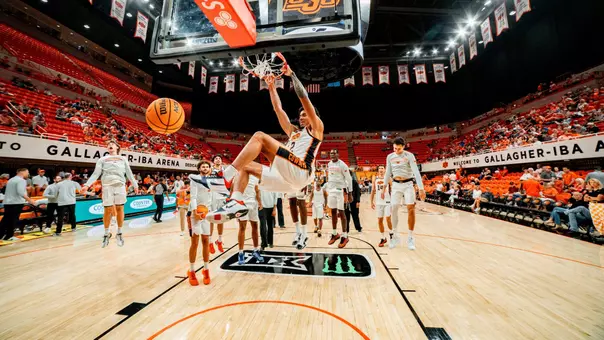
Now entering its 70th season, historic Gallagher-Iba Arena remains home to more national championships than any other facility in America. With its immense history, notorious reputation for noise and intimate setting, Gallagher-Iba has long been recognized as one of the best college basketball venues in the country.
The Athletics Center is a truly comprehensive sports complex, and its auxiliary facilities are a model for all other venues in the region. The Center features an academic counseling center, training facilities for all sports, a strength and conditioning center, expanded offices, a recruiting lounge, an auxiliary gym, wrestling facilities and the Heritage Hall museum. Heritage Hall features more than 5,000 square feet of displays highlighting OSU's many athletic and scholastic achievements.
A total of 14 luxury suites stretch across the west side of the facility, overlooking both the basketball court and the football field. These are the only luxury skybox suites that allow fans to view basketball or wrestling from the east side and football games from the west side. At 30 feet above the ground, the concourse level is illuminated with natural light from large window walls, where visitors to the arena can look out across Stillwater in all directions.
One of the nation's largest collegiate strength and conditioning facilities (30,000 square feet of space including the weight room and oval running track) is housed in the first level of the Athletic Center. The sports medicine facility boasts a cutting-edge Hydroworks Therapy Pool with a variable-speed treadmill for student-athletes to rehab injuries safely and effectively by running in water.
This magnificent building underwent a massive $55 million renovation and expansion project and is now part of the OSU Athletics Center. Funding of the project was a total team effort, supported by Oklahoma State students (through a self-imposed activity fee), private donations, loyal season-ticket holders and a use tax voted on by the citizens of Stillwater.
Construction commenced with a groundbreaking ceremony on January 12, 1999 and was completed in December of 2000. Through the course of the renovation, seating in Gallagher-Iba Arena was expanded from 6,381 to 13,611, while still providing an up-close view from any seat in the house. OSU students account for approximately one-third of the arena's total seats.
In order to complete the project on schedule while not missing a home basketball game during the 1999-2000 season, an ingenious plan was devised to allow construction work during the day but allow games to be played at night and on weekends.
The original Gallagher-Iba Arena was encapsulated by a new roof structure and concourse. Supporting the entire roof structure are two massive box trusses, nearly a football-field long, 40 feet tall and weighing one million pounds each. Once it was enclosed by the new structure, demolition began on the existing roof structure and upper wall. Construction more than doubled the height of arena from 60 feet to more than 120 feet.
Through the course of the project, three buildings became one: Gallagher-Iba Arena, the football coaches building and the weight training & locker room. In addition, a new structure, housing Academic Services and the auxiliary gym, was built at the south end of the Athletic Center.
Since 1938, Gallagher-Iba Arena has stood as one of America's premier college sports venues.
The original structure, called the 4-H Club and Student Activity Building when it was built in 1938 at a cost of $1.5 million, and was dubbed the "Madison Square Garden of the Plains," standing as one of the premier sporting venues in the region. The arena was unveiled in grand fashion, as national basketball powers Oklahoma State and Kansas opened the facility on December 9, 1938, in a game that matched coaching legends Henry Iba and Phog Allen. Mr. Iba's Cowboys won that game, 21-15.
The facility was quickly rechristened as Gallagher Hall in honor of fabled Oklahoma A&M wrestling coach Ed Gallagher.
Gallagher is widely renowned as the father of modern amateur wrestling, and crafted much of the sport while serving as Oklahoma A&M wrestling coach from 1916-40. In his 23 years at the helm, OSU won 11 team national championships and compiled a 138-5-4 dual record. Gallagher was also an outstanding athlete while attending Oklahoma A&M. He was captain of the track team for three years, and his 99-yard run against Kansas State in 1908 still stands as the longest football run in school history.
The facility would see a second name change in 1987, when the Board of Regents amended Gallagher Hall's name to recognize legendary Cowboy basketball coach Henry Iba.
During his tenure in Stillwater, Mr. Iba served as a great influence the game of basketball. It was in Gallagher-Iba Arena where Mr. Iba shaped many of the philosophies that many basketball coaches still teach today. He coached in 1,105 collegiate games, and his 767 career wins rank eighth in NCAA Division I history. Mr. Iba served as coach and athletic director at Oklahoma State from 1935 to 70, and in those 36 seasons, posted a 655-316 record while guiding the Cowboys to 13 league championships, eight NCAA appearances and the 1945 and 1946 NCAA Championships.
Two seats are permanently reserved for Gallagher and Iba in the southeast corner of the arena on the concourse level.
One of the proudest features at Gallagher-Iba Arena happens to be one of the oldest. Eddie Sutton Court, the gym's original white maple floor, is still in use today and undoubtedly the oldest and most heralded court still being used by a major college team today.
The floor, known affectionately for decades as "Mr. Iba's Court," was a host to basketball history from its inception. The first basketball game on the court matched up traditional powers Oklahoma A&M and the University of Kansas, with legendary coaches Henry Iba and Forrest "Phog" Allen guiding their teams from the sideline. In its 70 years of service, Eddie Sutton Court has arguably seen more college basketball icons play and coach than any other single court in the sport's history. Many of the coaching philosophies that shaped the game of basketball and influenced the careers of numerous coaches were first formulated by Mr. Iba on the fabled white maple.
The court was officially named in Eddie Sutton's honor on January 15, 2005, in a ceremony following Oklahoma State's 83-73 victory over Iowa State. The win was the 768th of Sutton's career and moved Sutton ahead of Henry Iba, his mentor who coached him during his 36 years at Oklahoma State.
Eddie Sutton Court was redesigned in the summer of 2008, after Oklahoma State officials sought to create a design that's unique to Oklahoma State while honoring the rich history of Gallagher-Iba Arena. Here's a look back at the court designs of the last 20 years, as well as the court as it appeared in 1957 before Oklahoma A&M was renamed Oklahoma State University:
| In 2008, the Oklahoma State athletic department offered fans the opportunity to vote for one of eight possible design options for Eddie Sutton Court in Gallagher-Iba Arena. The winning design borrows greatly from the legacy of the arena - providing a traditional look that hearkens back to the days of Henry Iba, while maintaining a link to more recent success through the use of the modern athletic marks. |
| Eddie Sutton Court saw a far less substantial redesign after the completion of the 2006 season. The Big 12 10th Anniversary logo was removed and in its place was the new primary logo for the Big 12 Conference that had been unveiled in 2004. This court design was replaced during the summer of 2008 with a design that better complements the arena's history. | During the summer of 2005, the court saw its biggest redesign since 2001. The biggest change was an orange gradient to help hide scuff marks underneath the basket. The "Gallagher-Iba Arena" text was removed, allowing for a slightly larger Eddie Sutton Court signature. A logo recognizing the Big 12's 10th year was placed over the existing Big 12 logo. |
| On January 15, 2005, the Oklahoma State Cowboys defeated the Iowa State Cyclones and secured head coach Eddie Sutton's 768th career victory. The athletic department honored Sutton after the game with a commemorative trophy and the announcement that Gallagher-Iba's original white maple floor would be named in his honor. Not long after this game, Coach Sutton's signature was added to the court, just below the names of legendary wrestling coach Ed Gallagher and Sutton's mentor, Henry Iba. | With the completion of the "Raise the Roof" campaign to renovate and expand Gallagher-Iba, and the unveiling of the new athletic marks, the court was in need of an overhaul. The new, much larger, O-State logo was placed at center court. The updated OSU Brand was placed in the lanes, and the new "Oklahoma State" wordmark was positioned along the baselines. Pistol Pete received a makeover as well, giving him more of a realistic appearance. The Gallagher-Iba Arena text and Big 12 Conference logo was also added. |
| This court is one of the striking visuals from the booming resurgence of Cowboy basketball in the 1990's. The block O-State mark now graced the center court circle, replacing the OSU Brand from the previous design; however, the Brand is set for a comeback in its larger and more modernized form in time for the 2008-09 season. | This predominantly orange design served as a precursor for things to come on Eddie Sutton Court. While the orange color and "Cowboys" and "Cowgirls" text didn't survive the next redesign, a few key features did. The white "Oklahoma State" text on the baselines and Pistol Pete logos patrolling the sidelines remained in place until 2001. |
| The courts of the 1940's and 50's were very simple, but with good reason in Oklahoma A&M's case. The artistry created on this canvas was the philosophies of legendary coach Henry Iba. Iba's teams set a new standard for defense and discipline in basketball - standards that still apply to the game today. | While you wouldn't find any sort of striking logo on the white maple floor of Gallagher Hall in 1957, Oklahoma A&M is still cleverly represented by the black circle filled with a smaller orange disk, forming a large "O," with the letters 'A' and 'M' on opposite sides of the halfcourt line. |