Oklahoma State University Athletics
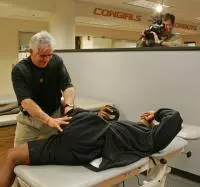
OSU athletic trainers showcase job, facilities
March 29, 2006 | General
But not near as many know the anterior talofibular ligament connects the fibula (lateral ankle bone) to the talus.
As part of National Athletic Training Month, the Oklahoma State athletic trainers spoke to members of the media Wednesday about the importance of their job and gave an in-depth tour of the athletic training facilities.
“Athletes stand a 50-50 chance of getting injured,” said head athletic trainer Terry Noonan. “Of that 50, 10 percent will be serious. How many times have you tweaked an ankle, tweaked a back, jammed a finger and wondered what to do about it?
“We're the type of people that can help you.”
Noonan also explained why OSU's athletic trainers are better at treating athletes than many of their counterparts across the nation.
“There are things we do that other schools are not doing,” Noonan said. “Erin (Steinkamp), my assistant in football, and I spent four or five days in L.A. taking a special course on active release. There was only three athletic trainers in that course.
“That puts us a step ahead of some of the other individuals.”
A hot topic in the session was the disclosure of athletic injuries to the media and public.
“It's not that we don't want to communicate with you, it's that we can't,” Noonan said. “There are a lot of guidelines that we have to follow. There are a lot of privacy issues.”
Noonan said OSU athletics is protected by the Family Educational Rights and Privacy Act, which was a decision made by a legal counsel that represents the university.
He said under this act, he is allowed to disclose what body part is injured and when the athlete can return to play status. But, he said he is not allowed to share the diagnosis, the diagnostic testing results or the surgical information with anyone other than the athlete.
“I cannot legally say they have a third-degree ankle sprain or a fractured arm,” Noonan said. “I can't give you the results of an MRI without the specific permission from that person.”
Following the lecture, the media was given an extensive tour of the athletic training room for the first time.
Steinkamp, an assistant athletic trainer, gave tours of the rehab center, taping area and the treatment center, before Brad Warrick, a sports medicine fellow, explained the X-ray procedure and drug disbursement.
“We have a pharmacy here, so players don't have to leave with a prescription and it helps them get to class quicker, “ Warrick said. “We have anything available, but narcotics.
“On gamedays, we have narcotics in our bag, but we have to keep a detailed log of disbursement.”
Noonan then showed off the water rehab center, which features a state-of-the-art water treadmill, which OSU was one of the first schools to use.
Noonan said it allows athletes to rehab in ways they cannot do on land. At 4 1/2 feet deep, with jets going and a treadmill speed of 7.8 mph, athletes run at an equivalent of 10 mph on land.
Athletes can also use the aquatic treadmill to go through game situations while rehabbing from an injury.
“If you're a running back, you can run for 12 seconds and then rest for 25 seconds by hanging onto the side and kicking,” Noonan said. “We can also simulate fumbles and interception.”
Right before leaving, members of the media got to see the athletic trainers at work.
While many football players were getting their ankles taped in preparation for Wednesday's practice, Steinkamp helped newcomer Anthony Parks put in a pair of new Nike contacts, which eliminate all blue light in the prism.
Steinkamp said the blue light creates the glare that can affect a player's sight during a play. She also said the contacts are primarily worn by the skill position players, such as running back, receiver and cornerbacks.
While watching his teammate get used to the red-colored contacts, receiver D'Juan Woods said, “With those contacts, you can almost stare directly at the sun.”
For more information on National Athletic Training Month or the profession, go to www.nata.org.