Oklahoma State University Athletics
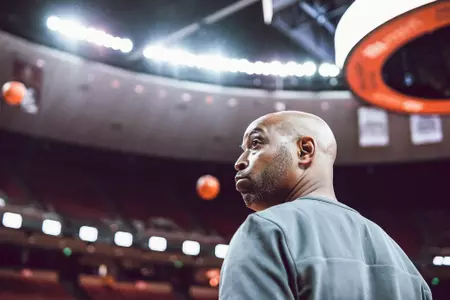
Photo by: OSU Athletics
Boynton's Battalion: Terrence Rencher Adds Prolific On-Court Experience, Coaching Knowledge to Stillwater
October 13, 2022 | Cowboy Basketball
Everyone has their own passion.
Passions stem from a variety of places. Whether it comes from an activity, a lifestyle, or a love, passions help make us who we are as a person.
For Terrence Rencher, one of three assistant coaches hired by Mike Boynton prior to the 2021-22 season, his passion comes from the game of basketball. From a star-studded high-school career, a record-shattering college tenure, a 12-year professional career and time coaching professionally – Rencher breathes basketball.
Bright Lights In The Big Apple
Born in The Bronx, New York, Terrence Rencher has always been surrounded by basketball.
With his father, Paul Rencher Sr., being a reputable player in his neighborhood and his older brother playing high-level high school basketball – Terrence had his sights set on high-school basketball early on.
"I was around the New York Basketball scene for a while," Rencher said. "I remember seeing Kenny Smith playing high-school basketball. I was young, obviously, but think of how long ago that was. So as a kid, all I wanted to do was be good in that league. I really didn't think beyond that. My immediate goal as a kid was to be a good high-school player because I knew how reputable that league was, and if you were one of the better players in that league, then you would have opportunities to play big-time college basketball."
Behind the tutelage of his father and older brother, Terrence blossomed as a child, developing into one of the better kids in his neighborhood. By the time he entered middle school, he asserted himself as a top candidate for making the Riverside Church Hawks, one of New York's top basketball clubs at the time.
During his tryout period with the Hawks – Rencher's game hit the national stage – getting a glimpse of how large the recruiting scene truly was in the process.
"You know it's funny," Rencher said. "I got exposed to the 'hoax' or the political nonsense behind kids being ranked early. I saw it. Obviously, as a kid, you want to see your name, be ranked and be regarded amongst other good players. For instance, when I was in seventh grade, the club for the AAU Team, Riverside Church, that I was going to try out for, had tryouts. They had kids from every part of the city. I tried out for the 12-U Team. I was familiar with the coaches because my older brother played at that program, and I was pretty good. I was going to be on that team.
"There were two prominent travel teams in New York at that time. There was Riverside Church and the [Bronx] Gauchos. So, a guy from Sports Illustrated came to this practice, and he asked the coach, 'who's your best seventh-grade player?' The coach pointed at me. Probably two weeks later, my name is in Sports Illustrated as one of the best seventh graders in the United States.
"Immediately, I was so proud to be in Sports Illustrated as a 12-year-old, but I was like, 'how did they figure that out?' So early on, I knew there was more stuff to where these kids get ranked, and you see kids gain popularity through rankings. That was an early experience, but it also served to give me some confidence at the same time. Seeing my name as a top seventh grader in the country really catapulted me to believe I could play with the rest of the kids in New York City. It's a big city, but you start out playing in your neighborhood, and then it builds from there."
Following his cameo appearance in Sports Illustrated, Rencher remained fixated on making the New York Catholic High School Basketball League. He did so, making the basketball team at Saint Raymond's High School, one of the premier programs in the state.
"I played in the high school league known as the 'Baby Big East,'" Rencher said. "Just in my district, we had Jamal Mashburn, who went on to be an NBA All-Star, Malik Sealy, rest in peace, who had a really good NBA career, and a bunch of high-level Division-1 players. In the city, there was Kenny Anderson, who was the No. 2 pick in the draft. Guys went to North Carolina, Georgia Tech, Arizona, Syracuse, there was so much depth at that time it was really about establishing a name for yourself."
Rencher did establish a name for himself. While playing for Saint Raymond, Rencher climbed the ranks en route to big-time attention as an upperclassman. As a senior, Rencher averaged over 17 points per game, netting 1991 Mr. New York Basketball honors.
Texas Ties
As Rencher garnered buzz around collegiate circles for his play at Saint Raymond, one thing became clear in his recruiting process. He was looking for a change.
After competing against players from the New York area for all his life to that point, a place where Terrence could play his brand of basketball with a new assortment of players was of utmost priority. He found his solution at the University of Texas at Austin.
"I took my visit to Texas, it was my very first official visit," Rencher said. "I came home, and had a gut feeling, 'I want to go there and try that.' It was a different region of the country, but I didn't feel like they had a player of my archetype. Texas was more the athletic guys, the run-and-jump guys. The city type of feel and skill I brought to the table I felt was going to be really appreciated, and my coach at the time, Coach [Tom] Penders, he was a guy from Connecticut, he had an affinity for guards from the East Coast – so we really hit it off.
I looked back on my deal; I was the easiest Mr. Basketball to ever sign. I went on a visit. I felt good about it. I didn't list the pros and cons about it and go on eight visits. I just felt a gut feeling and it actually worked out for me."
The jump from New York basketball to Division-1 play at Texas was not seamless for Rencher. Entering campus as a 6-foot-3, 170-pound shooting guard, he had to adjust his game to the next level.
"My success wasn't immediate [at Texas,]" Rencher said. "I remember my first couple of weeks at practice, I didn't think I could do it. I was physically overwhelmed. All of the other guards were 6-foot-4, 6-foot-5. ex-Texas track athletes and football players. They were jumping through the roof, running fast, they're strong, and for the first couple weeks of practice, I was like, 'maybe I have to go to Fordham. I don't know if I can do this.
"But, I knew, even though it was physically difficult initially, I always felt my craft, my knowledge of the game was going to lift me. My basketball intellect carried me past the athletes. That's how my freshman year went, it wasn't a physical deal because I was 6-foot-3, 170 pounds and I was playing against men 21-22 years old. But again, I just had a certain understanding of how the game was played to where I wasn't reliant on raw athleticism."
Rencher adjusted his game accordingly as a freshman, leading the Longhorns in total points (648) en route to averaging 19.1 points, 4.3 rebounds and 3.6 assists, being named the 1992 Dick Vitale National Freshman of the Year at the conclusion of the season.
Rencher's legacy continued to compile at Texas. Playing a full four years with the Longhorns, he posted career averages of 18.6 points, 5.0 rebounds, 3.5 assists and 2.1 steals across 124 games, helping to guide the group to a trio of March Madness entrances and conference titles.
Individually, he ended his college career as the Texas all-time leader in points (2,306) and steals (255) while ranking seventh in the assists department (440.)
"Leading in points is big, don't get me wrong," Rencher said. "Obviously, that's the eye-catching thing, but the steals are a great source of pride for me as well. Now, does that make you a good defensive player? No, not necessarily. But, for me personally, I've always had pride in being a good basketball player. So, I wanted to score 20 and give you eight. So that was kind of how I approached it. And then, on top of that too, we played fast. We were like havoc before havoc. They called us the 'Running Horns', we had it on our uniforms. We played really fast-paced basketball, a lot of pressure defense. But again, I think that just goes to my understanding. I just had a good understanding of positioning, anticipation, and who we were playing against. I really took it seriously in terms of wanting to be prepared and put myself and my teammates in positions to be successful.
"I tell our players this all the time. Part of the reason I ended up having the IQ and those things, I watched a lot of basketball as a kid. And I would listen. I didn't turn the T.V. on and put the music on or turn a video game on another T.V. I watched the game and listened to the commentary because those guys told me what a good player was. I would listen to what a good shooting guard was. Whatever they said about my position, I wanted to add to my game. And I just got that from listening to the T.V. I think information gathering for me was part of my development, not just what I saw, but what I heard and how I applied that."
Embracing Opportunity: Playing in the Pros
Rencher received a bevy of opportunities by the conclusion of his college career. From being a marquee piece at Riverside Church, Mr. New York Basketball at Saint Raymond's and netting historic honors at Texas – the then 22-year-old had his sights set on the next level.
June 28, 1995, he earned his ticket to the next level.
As the lone Longhorn selected in the 1995 NBA Draft, Rencher was selected with the third pick in the No. 32 by the Washington Bullets. Subsequently, his draft rights were dealt to the Miami Heat in a four-player deal.
Twenty-two years is a long time ago by NBA standards. While, in this day and age, second-round picks can net guaranteed contracts for multiple seasons, it was a rarity for any sum of guaranteed salary to go to a second-round pick in 1995.
Initially, Rencher was the exception to that standard.
"On the Miami Heat's draft board, they had me as the No. 18 prospect, but they only had one pick that year," Rencher said. "With the No. 10, they selected Kurt Thomas from TCU. He led the nation in scoring and rebounding that year. So, they had me on their board at No. 18. They were trying to make trades with teams starting with that pick [pick No. 18] in the draft. None of it came together until the No. 32 pick in the second round. They actually told my agent that because they had me slotted there on their board, they were willing to give me a multi-year guaranteed deal because they considered me a first-round talent."
While Rencher's first introduction to the Heat organization had him slated to be a focal developmental piece, a series of organizational and league-wide events led to the guard's role being unclear heading into the season.
"My snake bites from that time were crazy because there was a lockout that summer," Rencher said. "There was no Summer League. There was nothing. It was shut down. Then the Heat go through a transition phase. Pat Riley wasn't part of the organization during that draft. But, later on in the summer, he took over as president, and his whole deal was, 'I'll guarantee you one year at the minimum,' and that was that. In any other circumstance, I could've gotten a two-or-year guaranteed deal, and who knows how my career turns out if I feel like I have that kind of time to mature in the NBA.
"The more years you have in your contract, the more opportunities you'll have. That was an element that was out of control. But those are the types of things that happen to change the trajectory of fringe guys."
As a bench piece in his rookie season, head coach Pat Riley tended to exhaust minutes towards the veteran members of the backcourt, leaving Rencher outside of the regular rotation.
Logging 34 appearances and one start for the Miami Heat, Rencher was dealt to the Phoenix Suns at the 1996 NBA Trade Deadline, joining a veteran-filled roster in the Valley.
"[At the deadline,] I got traded to the Suns and it was an older team," Rencher said. "It was after they made their Finals run to play against the Bulls. We had Charles Barkley, Danny Manning, Kevin Johnson and all these older guys at the end of their rope. And we never practiced.
"I had injured my ankle in Miami, and I was out for a few weeks. So, after a couple of games in Phoenix, they came to me and said, 'listen, we have to take somebody off our injured list, and we have to put somebody on there. So, we're going to put you on the injured list.' That was it, that was my season. It was February, and I was done with an ankle injury without having a chance to prove myself or whatever the case may be.
"I didn't help myself the way I reacted to that. I probably wasn't the professional I needed to be in that circumstance. I'm not going to say that killed my desire to become an NBA player, but it didn't help."
Posting career averages of 2.9 points, 1.2 rebounds and 1.5 assists across 36 games in the NBA, Rencher concluded his NBA venture after being the final training camp cut by the Cleveland Cavaliers in 1996.
"After that experience, I played in the CBA the year after, which is pretty much what the G League is now. I looked at that and said, 'do I want to keep fighting this fight?' Because once you're out of the NBA, if you're not on a roster, trying to do the Summer League, and beat all those odds, it gets crazy.
"I just made the decision that I wanted to be a key component of a team and make some good money, so I went to Europe and dug into that. I did come back and play Summer League a couple of times, but, again, your summers when you play in Europe are already kind of short. So, you come home and play spot minutes in the Summer League and turn around and have to come back. So, I left that dream alone pretty early in terms of the NBA after my experience and went to Europe.
"I had a great time in Europe. Those fans are so passionate. The games are so lively over there. And to just be a key component of a team was more important to me than trying to fight for a roster spot over in the NBA."
In a prolific post-NBA career, Rencher played in multiple top overseas leagues, including the Israeli Premier Basketball League, the Basketball Bundesliga and the Greek Basket League, among others.
Overall, he played 12 professional seasons for 14 different organizations across 10 leagues, competing in the United States, Israel, Italy, Germany and Greece.
Degrees, Determination, and Durant
After putting a close to a 12-year professional career, Rencher, then age 34, returned back to Austin, Texas, to complete another journey – earning his bachelor's degree.
"I was in my early 30s," Rencher said. "I knew it [my playing days] wasn't going to last too much longer. Initially, I wanted to play until I was 40, I don't know why I wanted to do that. But I'm a realist. I started feeling my body break down slowly, so I went back and got my degree.
"I had a deal with my mom [to finish college.] I didn't think she really believed me when I told her I was going to finish it. Then, my wife, her side of the family is educated to a whole different level. There was a lot of doubt if I was going to follow up and finish that deal."
Twelve years removed from setting all-time records on the basketball team, Rencher had set another milestone – earning a B.S. in applied learning and development on Dec. 8, 2007.
"The best part was walking across the stage and getting my degree. My oldest daughter was five years old at the time, and her seeing that [was special.] Those experiences are definitely very vivid in my mind because of how important they were to other people around me to see and experience it with me."
Coincidentally, while Rencher was earning his degree in education, he was already injecting his extensive amount of knowledge into other students on campus. He was an academic mentor for the men's basketball team.
As an academic mentor, Rencher assisted in scheduling and assisting the men's players throughout the season. However, he was also able to partake in up-close experiences with the team, reinvigorating his calling in the process.
"I was around [Texas basketball] the year Kevin Durant was a freshman," Rencher said. "Coach [Rick] Barnes gave me an opportunity to be around. He gave me an academic mentor role. I spent time with those guys in the study hall. I was there anyway doing my own stuff. I think my presence, experiences, and my stature at the university were things that they felt would be a positive influence on those guys. I got the chance to travel some and be around and watch film with them.
"I knew I wanted to stay in the game of basketball. I didn't know at what capacity at the time. I was flirting around doing some broadcasting stuff and training. But being around the program at that point kind of told me, 'You got more to give. You need to be part of a staff and pour back into these young men.'"
Coaching Carousel
In establishing his continued love for the game, Rencher carried stints as the head coach of Regents High School in Austin, Texas in 2007 and manned a graduate assistant role at Saint Louis in 2008 before officially entering the coaching scene.
Since 2008, Rencher has been an assistant coach for Texas State, Tulsa, Sam Houston State, New Mexico, San Diego and Creighton before his time in Stillwater. In 2020, he played a pivotal role in Creighton's Big East title and eventual appearance in the Sweet 16.
"I've worked for Rick Majerus, who's one of the best basketball minds I've ever been around," Rencher said. "Doug Wojcik at Tulsa, who's a really intense, organized, detailed guy. Danny Kaspar, Texas State, he's a very good defensive mind. Craig Neal at New Mexico was really good offensively. Just picking up stuff from all of those spots [has really helped,] and then putting my own twist on it.
"I think a big part of it as well is learning from some of these great coaches on what I wouldn't do in that position. Coach Majerus told me from the first time we met, 'every time you come in the office and every day we work. If things come up, I want you to put yourself in my shoes as much as you can.' That's kind of the approach that I try to take."
Destination: Stillwater
Rencher's phone rang. The call was from Mike Boynton.
After the conclusion of the 2020-21 season, Rencher was fresh off a 22-9 record in his second season with the Creighton Blue Jays. For the Cowboys, they were looking to add onto their staff for the upcoming season.
With previous ties, Boynton knew he wanted to bring Rencher on staff.
"We're both New York guys," Rencher said. "I'm a little older than coach but the basketball community is small already and then you talk about New York and it's even smaller. We've always had a good rapport over the years in terms of coaching when we run into each other or just checking in with each other on the phone from time to time and mutual acquaintances.
"When he reached out to me, it was a no-brainer. I was at Creighton, and we were having great success. Coach McDermott is outstanding, treated my family and I great. It was an awesome experience at Creighton. I just think this guy [Boynton] is just a different breed. I can't really explain the coach's aura, but I know people that have greatness in them and are on their way to doing great things. Just instinctively, I wanted to be a part of helping him do some special things here. Obviously, you're always grateful to get that trust and that opportunity. I just believe in him."
As for Boynton, he views Rencher's playing experience, teaching skills and unique perspective as major pluses moving forward.
"With his long-playing career, Terrence brings a great perspective to our players who all have a desire to play at the highest level, '' Boynton said. "He's been around some really quality coaches and understands how to teach and develop. He does most of his work with our perimeter players, specifically our wing players."
For Rencher, he's looking forward to player development – both on and off the floor.
"I just want to be here for the next generation of men, Rencher said. "I think that's part of my duty, as a man, to try and affect the next generation of young men. And the best way for me, knowing who I am, is by using this game. Using this game as a vehicle. My experiences and my triumphs and failures through my experiences could be priceless to some of these young people."
Passions stem from a variety of places. Whether it comes from an activity, a lifestyle, or a love, passions help make us who we are as a person.
For Terrence Rencher, one of three assistant coaches hired by Mike Boynton prior to the 2021-22 season, his passion comes from the game of basketball. From a star-studded high-school career, a record-shattering college tenure, a 12-year professional career and time coaching professionally – Rencher breathes basketball.
Bright Lights In The Big Apple
Born in The Bronx, New York, Terrence Rencher has always been surrounded by basketball.
With his father, Paul Rencher Sr., being a reputable player in his neighborhood and his older brother playing high-level high school basketball – Terrence had his sights set on high-school basketball early on.
"I was around the New York Basketball scene for a while," Rencher said. "I remember seeing Kenny Smith playing high-school basketball. I was young, obviously, but think of how long ago that was. So as a kid, all I wanted to do was be good in that league. I really didn't think beyond that. My immediate goal as a kid was to be a good high-school player because I knew how reputable that league was, and if you were one of the better players in that league, then you would have opportunities to play big-time college basketball."
Behind the tutelage of his father and older brother, Terrence blossomed as a child, developing into one of the better kids in his neighborhood. By the time he entered middle school, he asserted himself as a top candidate for making the Riverside Church Hawks, one of New York's top basketball clubs at the time.
During his tryout period with the Hawks – Rencher's game hit the national stage – getting a glimpse of how large the recruiting scene truly was in the process.
"You know it's funny," Rencher said. "I got exposed to the 'hoax' or the political nonsense behind kids being ranked early. I saw it. Obviously, as a kid, you want to see your name, be ranked and be regarded amongst other good players. For instance, when I was in seventh grade, the club for the AAU Team, Riverside Church, that I was going to try out for, had tryouts. They had kids from every part of the city. I tried out for the 12-U Team. I was familiar with the coaches because my older brother played at that program, and I was pretty good. I was going to be on that team.
"There were two prominent travel teams in New York at that time. There was Riverside Church and the [Bronx] Gauchos. So, a guy from Sports Illustrated came to this practice, and he asked the coach, 'who's your best seventh-grade player?' The coach pointed at me. Probably two weeks later, my name is in Sports Illustrated as one of the best seventh graders in the United States.
"Immediately, I was so proud to be in Sports Illustrated as a 12-year-old, but I was like, 'how did they figure that out?' So early on, I knew there was more stuff to where these kids get ranked, and you see kids gain popularity through rankings. That was an early experience, but it also served to give me some confidence at the same time. Seeing my name as a top seventh grader in the country really catapulted me to believe I could play with the rest of the kids in New York City. It's a big city, but you start out playing in your neighborhood, and then it builds from there."
Following his cameo appearance in Sports Illustrated, Rencher remained fixated on making the New York Catholic High School Basketball League. He did so, making the basketball team at Saint Raymond's High School, one of the premier programs in the state.
"I played in the high school league known as the 'Baby Big East,'" Rencher said. "Just in my district, we had Jamal Mashburn, who went on to be an NBA All-Star, Malik Sealy, rest in peace, who had a really good NBA career, and a bunch of high-level Division-1 players. In the city, there was Kenny Anderson, who was the No. 2 pick in the draft. Guys went to North Carolina, Georgia Tech, Arizona, Syracuse, there was so much depth at that time it was really about establishing a name for yourself."
Rencher did establish a name for himself. While playing for Saint Raymond, Rencher climbed the ranks en route to big-time attention as an upperclassman. As a senior, Rencher averaged over 17 points per game, netting 1991 Mr. New York Basketball honors.
Texas Ties
As Rencher garnered buzz around collegiate circles for his play at Saint Raymond, one thing became clear in his recruiting process. He was looking for a change.
After competing against players from the New York area for all his life to that point, a place where Terrence could play his brand of basketball with a new assortment of players was of utmost priority. He found his solution at the University of Texas at Austin.
"I took my visit to Texas, it was my very first official visit," Rencher said. "I came home, and had a gut feeling, 'I want to go there and try that.' It was a different region of the country, but I didn't feel like they had a player of my archetype. Texas was more the athletic guys, the run-and-jump guys. The city type of feel and skill I brought to the table I felt was going to be really appreciated, and my coach at the time, Coach [Tom] Penders, he was a guy from Connecticut, he had an affinity for guards from the East Coast – so we really hit it off.
I looked back on my deal; I was the easiest Mr. Basketball to ever sign. I went on a visit. I felt good about it. I didn't list the pros and cons about it and go on eight visits. I just felt a gut feeling and it actually worked out for me."
The jump from New York basketball to Division-1 play at Texas was not seamless for Rencher. Entering campus as a 6-foot-3, 170-pound shooting guard, he had to adjust his game to the next level.
"My success wasn't immediate [at Texas,]" Rencher said. "I remember my first couple of weeks at practice, I didn't think I could do it. I was physically overwhelmed. All of the other guards were 6-foot-4, 6-foot-5. ex-Texas track athletes and football players. They were jumping through the roof, running fast, they're strong, and for the first couple weeks of practice, I was like, 'maybe I have to go to Fordham. I don't know if I can do this.
"But, I knew, even though it was physically difficult initially, I always felt my craft, my knowledge of the game was going to lift me. My basketball intellect carried me past the athletes. That's how my freshman year went, it wasn't a physical deal because I was 6-foot-3, 170 pounds and I was playing against men 21-22 years old. But again, I just had a certain understanding of how the game was played to where I wasn't reliant on raw athleticism."
Rencher adjusted his game accordingly as a freshman, leading the Longhorns in total points (648) en route to averaging 19.1 points, 4.3 rebounds and 3.6 assists, being named the 1992 Dick Vitale National Freshman of the Year at the conclusion of the season.
Rencher's legacy continued to compile at Texas. Playing a full four years with the Longhorns, he posted career averages of 18.6 points, 5.0 rebounds, 3.5 assists and 2.1 steals across 124 games, helping to guide the group to a trio of March Madness entrances and conference titles.
Individually, he ended his college career as the Texas all-time leader in points (2,306) and steals (255) while ranking seventh in the assists department (440.)
"Leading in points is big, don't get me wrong," Rencher said. "Obviously, that's the eye-catching thing, but the steals are a great source of pride for me as well. Now, does that make you a good defensive player? No, not necessarily. But, for me personally, I've always had pride in being a good basketball player. So, I wanted to score 20 and give you eight. So that was kind of how I approached it. And then, on top of that too, we played fast. We were like havoc before havoc. They called us the 'Running Horns', we had it on our uniforms. We played really fast-paced basketball, a lot of pressure defense. But again, I think that just goes to my understanding. I just had a good understanding of positioning, anticipation, and who we were playing against. I really took it seriously in terms of wanting to be prepared and put myself and my teammates in positions to be successful.
"I tell our players this all the time. Part of the reason I ended up having the IQ and those things, I watched a lot of basketball as a kid. And I would listen. I didn't turn the T.V. on and put the music on or turn a video game on another T.V. I watched the game and listened to the commentary because those guys told me what a good player was. I would listen to what a good shooting guard was. Whatever they said about my position, I wanted to add to my game. And I just got that from listening to the T.V. I think information gathering for me was part of my development, not just what I saw, but what I heard and how I applied that."
Embracing Opportunity: Playing in the Pros
Rencher received a bevy of opportunities by the conclusion of his college career. From being a marquee piece at Riverside Church, Mr. New York Basketball at Saint Raymond's and netting historic honors at Texas – the then 22-year-old had his sights set on the next level.
June 28, 1995, he earned his ticket to the next level.
As the lone Longhorn selected in the 1995 NBA Draft, Rencher was selected with the third pick in the No. 32 by the Washington Bullets. Subsequently, his draft rights were dealt to the Miami Heat in a four-player deal.
Twenty-two years is a long time ago by NBA standards. While, in this day and age, second-round picks can net guaranteed contracts for multiple seasons, it was a rarity for any sum of guaranteed salary to go to a second-round pick in 1995.
Initially, Rencher was the exception to that standard.
"On the Miami Heat's draft board, they had me as the No. 18 prospect, but they only had one pick that year," Rencher said. "With the No. 10, they selected Kurt Thomas from TCU. He led the nation in scoring and rebounding that year. So, they had me on their board at No. 18. They were trying to make trades with teams starting with that pick [pick No. 18] in the draft. None of it came together until the No. 32 pick in the second round. They actually told my agent that because they had me slotted there on their board, they were willing to give me a multi-year guaranteed deal because they considered me a first-round talent."
While Rencher's first introduction to the Heat organization had him slated to be a focal developmental piece, a series of organizational and league-wide events led to the guard's role being unclear heading into the season.
"My snake bites from that time were crazy because there was a lockout that summer," Rencher said. "There was no Summer League. There was nothing. It was shut down. Then the Heat go through a transition phase. Pat Riley wasn't part of the organization during that draft. But, later on in the summer, he took over as president, and his whole deal was, 'I'll guarantee you one year at the minimum,' and that was that. In any other circumstance, I could've gotten a two-or-year guaranteed deal, and who knows how my career turns out if I feel like I have that kind of time to mature in the NBA.
"The more years you have in your contract, the more opportunities you'll have. That was an element that was out of control. But those are the types of things that happen to change the trajectory of fringe guys."
As a bench piece in his rookie season, head coach Pat Riley tended to exhaust minutes towards the veteran members of the backcourt, leaving Rencher outside of the regular rotation.
Logging 34 appearances and one start for the Miami Heat, Rencher was dealt to the Phoenix Suns at the 1996 NBA Trade Deadline, joining a veteran-filled roster in the Valley.
"[At the deadline,] I got traded to the Suns and it was an older team," Rencher said. "It was after they made their Finals run to play against the Bulls. We had Charles Barkley, Danny Manning, Kevin Johnson and all these older guys at the end of their rope. And we never practiced.
"I had injured my ankle in Miami, and I was out for a few weeks. So, after a couple of games in Phoenix, they came to me and said, 'listen, we have to take somebody off our injured list, and we have to put somebody on there. So, we're going to put you on the injured list.' That was it, that was my season. It was February, and I was done with an ankle injury without having a chance to prove myself or whatever the case may be.
"I didn't help myself the way I reacted to that. I probably wasn't the professional I needed to be in that circumstance. I'm not going to say that killed my desire to become an NBA player, but it didn't help."
Posting career averages of 2.9 points, 1.2 rebounds and 1.5 assists across 36 games in the NBA, Rencher concluded his NBA venture after being the final training camp cut by the Cleveland Cavaliers in 1996.
"After that experience, I played in the CBA the year after, which is pretty much what the G League is now. I looked at that and said, 'do I want to keep fighting this fight?' Because once you're out of the NBA, if you're not on a roster, trying to do the Summer League, and beat all those odds, it gets crazy.
"I just made the decision that I wanted to be a key component of a team and make some good money, so I went to Europe and dug into that. I did come back and play Summer League a couple of times, but, again, your summers when you play in Europe are already kind of short. So, you come home and play spot minutes in the Summer League and turn around and have to come back. So, I left that dream alone pretty early in terms of the NBA after my experience and went to Europe.
"I had a great time in Europe. Those fans are so passionate. The games are so lively over there. And to just be a key component of a team was more important to me than trying to fight for a roster spot over in the NBA."
In a prolific post-NBA career, Rencher played in multiple top overseas leagues, including the Israeli Premier Basketball League, the Basketball Bundesliga and the Greek Basket League, among others.
Overall, he played 12 professional seasons for 14 different organizations across 10 leagues, competing in the United States, Israel, Italy, Germany and Greece.
Degrees, Determination, and Durant
After putting a close to a 12-year professional career, Rencher, then age 34, returned back to Austin, Texas, to complete another journey – earning his bachelor's degree.
"I was in my early 30s," Rencher said. "I knew it [my playing days] wasn't going to last too much longer. Initially, I wanted to play until I was 40, I don't know why I wanted to do that. But I'm a realist. I started feeling my body break down slowly, so I went back and got my degree.
"I had a deal with my mom [to finish college.] I didn't think she really believed me when I told her I was going to finish it. Then, my wife, her side of the family is educated to a whole different level. There was a lot of doubt if I was going to follow up and finish that deal."
Twelve years removed from setting all-time records on the basketball team, Rencher had set another milestone – earning a B.S. in applied learning and development on Dec. 8, 2007.
"The best part was walking across the stage and getting my degree. My oldest daughter was five years old at the time, and her seeing that [was special.] Those experiences are definitely very vivid in my mind because of how important they were to other people around me to see and experience it with me."
Coincidentally, while Rencher was earning his degree in education, he was already injecting his extensive amount of knowledge into other students on campus. He was an academic mentor for the men's basketball team.
As an academic mentor, Rencher assisted in scheduling and assisting the men's players throughout the season. However, he was also able to partake in up-close experiences with the team, reinvigorating his calling in the process.
"I was around [Texas basketball] the year Kevin Durant was a freshman," Rencher said. "Coach [Rick] Barnes gave me an opportunity to be around. He gave me an academic mentor role. I spent time with those guys in the study hall. I was there anyway doing my own stuff. I think my presence, experiences, and my stature at the university were things that they felt would be a positive influence on those guys. I got the chance to travel some and be around and watch film with them.
"I knew I wanted to stay in the game of basketball. I didn't know at what capacity at the time. I was flirting around doing some broadcasting stuff and training. But being around the program at that point kind of told me, 'You got more to give. You need to be part of a staff and pour back into these young men.'"
Coaching Carousel
In establishing his continued love for the game, Rencher carried stints as the head coach of Regents High School in Austin, Texas in 2007 and manned a graduate assistant role at Saint Louis in 2008 before officially entering the coaching scene.
Since 2008, Rencher has been an assistant coach for Texas State, Tulsa, Sam Houston State, New Mexico, San Diego and Creighton before his time in Stillwater. In 2020, he played a pivotal role in Creighton's Big East title and eventual appearance in the Sweet 16.
"I've worked for Rick Majerus, who's one of the best basketball minds I've ever been around," Rencher said. "Doug Wojcik at Tulsa, who's a really intense, organized, detailed guy. Danny Kaspar, Texas State, he's a very good defensive mind. Craig Neal at New Mexico was really good offensively. Just picking up stuff from all of those spots [has really helped,] and then putting my own twist on it.
"I think a big part of it as well is learning from some of these great coaches on what I wouldn't do in that position. Coach Majerus told me from the first time we met, 'every time you come in the office and every day we work. If things come up, I want you to put yourself in my shoes as much as you can.' That's kind of the approach that I try to take."
Destination: Stillwater
Rencher's phone rang. The call was from Mike Boynton.
After the conclusion of the 2020-21 season, Rencher was fresh off a 22-9 record in his second season with the Creighton Blue Jays. For the Cowboys, they were looking to add onto their staff for the upcoming season.
With previous ties, Boynton knew he wanted to bring Rencher on staff.
"We're both New York guys," Rencher said. "I'm a little older than coach but the basketball community is small already and then you talk about New York and it's even smaller. We've always had a good rapport over the years in terms of coaching when we run into each other or just checking in with each other on the phone from time to time and mutual acquaintances.
"When he reached out to me, it was a no-brainer. I was at Creighton, and we were having great success. Coach McDermott is outstanding, treated my family and I great. It was an awesome experience at Creighton. I just think this guy [Boynton] is just a different breed. I can't really explain the coach's aura, but I know people that have greatness in them and are on their way to doing great things. Just instinctively, I wanted to be a part of helping him do some special things here. Obviously, you're always grateful to get that trust and that opportunity. I just believe in him."
As for Boynton, he views Rencher's playing experience, teaching skills and unique perspective as major pluses moving forward.
"With his long-playing career, Terrence brings a great perspective to our players who all have a desire to play at the highest level, '' Boynton said. "He's been around some really quality coaches and understands how to teach and develop. He does most of his work with our perimeter players, specifically our wing players."
For Rencher, he's looking forward to player development – both on and off the floor.
"I just want to be here for the next generation of men, Rencher said. "I think that's part of my duty, as a man, to try and affect the next generation of young men. And the best way for me, knowing who I am, is by using this game. Using this game as a vehicle. My experiences and my triumphs and failures through my experiences could be priceless to some of these young people."
Taking on the NCAA Baseball Tuscaloosa Regional - Inside OSU Athletics with Josh Holliday
Friday, May 29
Oklahoma State's #1 Ranked Women's Basketball Portal Class - Inside OSU Athletics with Jacie Hoyt
Wednesday, May 27
Oklahoma State Postgame Sound (5-17-2026) - NCAA Softball Stillwater Regional Final
Monday, May 18
Stanford Postgame Sound (5-17-2026) - NCAA Softball Stillwater Regional Final
Monday, May 18