Oklahoma State University Athletics
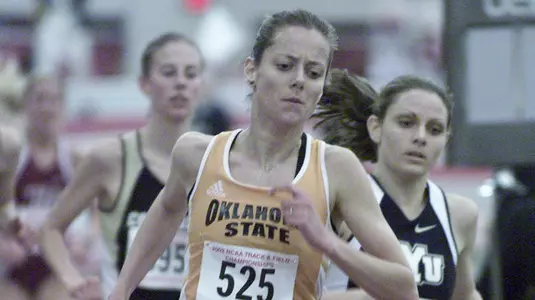
Looking Back on Siri Alfheim's NCAA Title
December 09, 2021 | Cowgirl Cross Country & Track
STILLWATER - Oklahoma State's Siri Alfheim won the 2002 NCAA title in the indoor 5,000 meter run. At the time when she accomplished that feat, she joined Christine McMiken and Jackie Goodman as the only Cowgirls to win indoor NCAA titles. About a week after winning the title, Alfheim visited with Alison Wade. Some excerpts from that Q&A :
by Alison Wade
With one lap to go in the 5,000-meter race at the 2002 NCAA Indoor Track & Field Championships, five runners remained in contention. The other four women had slightly stronger credentials, but Oklahoma State's Siri Alfheim pulled off a minor upset by sprinting to victory in a PR 16:12.28. A native of Norway, Alfheim did not take up running until she was 20 years old. Now, less than five years later, she has become one of Norway's - and the NCAA's - best runners. Alfheim had a strong cross country season in 2001, finishing second at the Big 12 Championships and winning the Midwest Regional. Hampered by the flu at the NCAA Championships, she finished a disappointing 93rd. A graduate student at Oklahoma State, Alfheim has been one of Oklahoma State's top runners since her arrival in January of 2001. She qualified for the 5,000m at the 2001 NCAA Outdoor Track and Field Championships, where she finished 19th in 16:35.35. We caught up with Alfheim on March 18th, nine days after her winning run.
Now that you've had some time to reflect on your NCAA 5,000 victory, how do you feel about the race and winning a national title?
It's the biggest thing I've ever done so far. I kind of like to run that way, because you never know how fast people are going to go out. I tried to stay in the back a little bit, to see what was going to happen.
You ran a very smart race. We didn't even see you because you were tucked in so well on the inside. There were a lot of different leaders but you just stayed tucked in behind the front pack.
I had a good spot so I just tried to stay there and keep on going, and figure out what was going to happen.
You surprised a lot of people with your win. Heading into the race, did you think you could win? Was that a goal?
No, that was not my goal. My goal was to finish as high up as I could. When I go out onto the track, my goal is always to do my best. I hoped to be All American. That was actually my goal. I didn't expect to win it at all. I was like, "Whoa. What did I just do?"
You looked pretty shocked when you crossed the finish line.
I was actually kind of shocked. It took a couple of minutes until I realized what I had done (laughs).
At what point during the race did you think you might win? Did your confidence build as the race progressed?
I just focused on the race, until [we had] 200 meters to go. When I went and nobody followed me, I kind of started to think, "Perhaps I'm going to win this." I just kept on going, but you never know if you can do it until you actually step over the finish line.
We just read that you didn't start running until you were 21. Is that true?!
Yeah. I was 21, or it was just before I turned 21, I think. I did aerobics and I biked. We always had tests in school and I didn't practice or anything and I always did okay on them. So I was thinking, "Perhaps if I practice a little I can run even faster." So I was just curious, I wanted try it. In the beginning, when I first started to run, I ran okay. I think I ran 18:30 after four months of practice or something, and I was so happy. Then I was injured and got sick. The rest of the season I didn't improve very much.
Were you running for a school team?
No, we don't have that in Europe.
What kinds of competitions were these, who would you be running against?
In Norway it's more like you run for a club or you just kind of run for yourself.
And you ran track and cross country?
No, we don't have cross country at all, only track.
Before you went to Oklahoma State, what were your best times?
I had run 9:44 in the 3k, 17:08 for 5k and 4:32 in the 1,500.
And how did you end up at Oklahoma State?
I went to Sweden to run a track meet, I didn't run that well, I think I was third or fourth. After the race, the coach from Oklahoma walked over and asked me if I wanted to come over and run for her school. I was like, "Sure!" I really wanted to try to run a little bit more and it didn't work that well at home. It's very cold and it rains a lot, we don't have very good training conditions. So I thought, "Okay, I'm going to try to give it one more shot and see if I can improve my times." So I decided to come.
And when did you first come to the U.S.?
In January of 2001.
There has to be some culture shock involved, moving from Norway to Oklahoma. What did you find to be the most surprising?
The summer. When it started to get really hot here, in May and June, I was so worn out. It doesn't get that hot at home. It just got warmer and warmer and worse and worse, the humidity got really high...
What else? It's different to be a student here as well. The relationships between the professors and the students are much better than at home. You have more contact with the professors and you get evaluated throughout the whole semester, at home you just have one exam at the end of the semester.
And also the track program is different here. I'm not used to how you can just go down to the training room and get treatment, they have ice baths... You can lift weights, you can go to the swimming pool and everything's right around you. In Norway, you have to do more of that on your own. But that depends on where you're living in Norway, as well.
Despite not starting to run competitively until your twenties, you must have been pretty active growing up.
I really enjoyed hiking and riding my bike all over the place. I used to do bike trips with my friends.
But it was more of a fitness focus rather than competitive sports?
Yeah, I did aerobics and a little bit of swimming, but everything was just on a fitness level.
But you had no idea that you were such a talented athlete?
(Modestly) I don't know, I don't know. I think the coaches at Oklahoma State did a really good job with me here.
by Alison Wade
With one lap to go in the 5,000-meter race at the 2002 NCAA Indoor Track & Field Championships, five runners remained in contention. The other four women had slightly stronger credentials, but Oklahoma State's Siri Alfheim pulled off a minor upset by sprinting to victory in a PR 16:12.28. A native of Norway, Alfheim did not take up running until she was 20 years old. Now, less than five years later, she has become one of Norway's - and the NCAA's - best runners. Alfheim had a strong cross country season in 2001, finishing second at the Big 12 Championships and winning the Midwest Regional. Hampered by the flu at the NCAA Championships, she finished a disappointing 93rd. A graduate student at Oklahoma State, Alfheim has been one of Oklahoma State's top runners since her arrival in January of 2001. She qualified for the 5,000m at the 2001 NCAA Outdoor Track and Field Championships, where she finished 19th in 16:35.35. We caught up with Alfheim on March 18th, nine days after her winning run.
Now that you've had some time to reflect on your NCAA 5,000 victory, how do you feel about the race and winning a national title?
It's the biggest thing I've ever done so far. I kind of like to run that way, because you never know how fast people are going to go out. I tried to stay in the back a little bit, to see what was going to happen.
You ran a very smart race. We didn't even see you because you were tucked in so well on the inside. There were a lot of different leaders but you just stayed tucked in behind the front pack.
I had a good spot so I just tried to stay there and keep on going, and figure out what was going to happen.
You surprised a lot of people with your win. Heading into the race, did you think you could win? Was that a goal?
No, that was not my goal. My goal was to finish as high up as I could. When I go out onto the track, my goal is always to do my best. I hoped to be All American. That was actually my goal. I didn't expect to win it at all. I was like, "Whoa. What did I just do?"
You looked pretty shocked when you crossed the finish line.
I was actually kind of shocked. It took a couple of minutes until I realized what I had done (laughs).
At what point during the race did you think you might win? Did your confidence build as the race progressed?
I just focused on the race, until [we had] 200 meters to go. When I went and nobody followed me, I kind of started to think, "Perhaps I'm going to win this." I just kept on going, but you never know if you can do it until you actually step over the finish line.
We just read that you didn't start running until you were 21. Is that true?!
Yeah. I was 21, or it was just before I turned 21, I think. I did aerobics and I biked. We always had tests in school and I didn't practice or anything and I always did okay on them. So I was thinking, "Perhaps if I practice a little I can run even faster." So I was just curious, I wanted try it. In the beginning, when I first started to run, I ran okay. I think I ran 18:30 after four months of practice or something, and I was so happy. Then I was injured and got sick. The rest of the season I didn't improve very much.
Were you running for a school team?
No, we don't have that in Europe.
What kinds of competitions were these, who would you be running against?
In Norway it's more like you run for a club or you just kind of run for yourself.
And you ran track and cross country?
No, we don't have cross country at all, only track.
Before you went to Oklahoma State, what were your best times?
I had run 9:44 in the 3k, 17:08 for 5k and 4:32 in the 1,500.
And how did you end up at Oklahoma State?
I went to Sweden to run a track meet, I didn't run that well, I think I was third or fourth. After the race, the coach from Oklahoma walked over and asked me if I wanted to come over and run for her school. I was like, "Sure!" I really wanted to try to run a little bit more and it didn't work that well at home. It's very cold and it rains a lot, we don't have very good training conditions. So I thought, "Okay, I'm going to try to give it one more shot and see if I can improve my times." So I decided to come.
And when did you first come to the U.S.?
In January of 2001.
There has to be some culture shock involved, moving from Norway to Oklahoma. What did you find to be the most surprising?
The summer. When it started to get really hot here, in May and June, I was so worn out. It doesn't get that hot at home. It just got warmer and warmer and worse and worse, the humidity got really high...
What else? It's different to be a student here as well. The relationships between the professors and the students are much better than at home. You have more contact with the professors and you get evaluated throughout the whole semester, at home you just have one exam at the end of the semester.
And also the track program is different here. I'm not used to how you can just go down to the training room and get treatment, they have ice baths... You can lift weights, you can go to the swimming pool and everything's right around you. In Norway, you have to do more of that on your own. But that depends on where you're living in Norway, as well.
Despite not starting to run competitively until your twenties, you must have been pretty active growing up.
I really enjoyed hiking and riding my bike all over the place. I used to do bike trips with my friends.
But it was more of a fitness focus rather than competitive sports?
Yeah, I did aerobics and a little bit of swimming, but everything was just on a fitness level.
But you had no idea that you were such a talented athlete?
(Modestly) I don't know, I don't know. I think the coaches at Oklahoma State did a really good job with me here.

Friday, June 05
Friday, May 29
Wednesday, May 27
Monday, May 18