Oklahoma State University Athletics
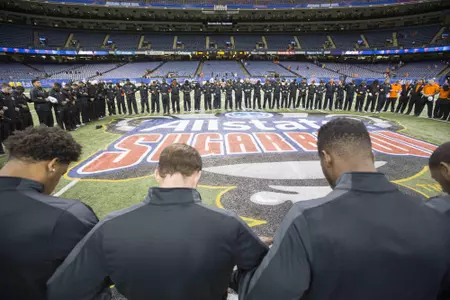
Photo by: Bruce Waterfield
Breaking Down The 2015 Season
January 13, 2016 | Cowboy Football
Season Review, Final Stats and Box Scores in PDF Format
STILLWATER - Oklahoma State was unranked in both the Associated Press and coaches polls to start the season, yet climbed to as high as No. 4 in the national rankings before settling in at No. 19 in the final A.P. poll.
The Cowboys were picked to finish fourth in the Big 12 in the preseason, yet played for the outright conference title on the final day of the regular season, eventually taking second in the league and securing the Big 12's berth to the Sugar Bowl.
Off the field, OSU set a program record by placing 22 players on the Academic All-Big 12 team.
So put simply, the Cowboys of 2015 exceeded expectations and even made history in matching a single-season school record by winning 10 games in a row.
The Cowboys finished 10-3 overall and 7-2 in the Big 12, and for the fourth time in the last seven seasons, played in a bowl game now referred to as one of the New Year's Six. OSU beat five teams who played in bowl games.
Perhaps more interesting than the team's final record was the path that the Pokes of 2015 took to get there. Coach Mike Gundy's bunch was not a particularly dominant team, but rather, one that found ways to win close games, which added up and added up to the Cowboys eventually posting their fourth 10-win season this decade. Only Alabama, Clemson, Florida State, Michigan State, Ohio State, Oklahoma, Oregon and Stanford have more 10-win seasons among Power Five conference schools since 2010.
The identity of the 2015 team was in its team chemistry, resilience and its ability to overcome its own flaws.
Three times during the course of the 2015 season did OSU erase a deficit of at least 15 points to win a game and the Pokes were 4-0 in games decided by one score. The Cowboys became the first team in Big 12 history to achieve a top-two finish in the conference standings despite averaging less than 130 rushing yards per game and not having a 750-yard rusher.
While struggles in the run game were a theme of the season, the Cowboys were able to make up for it thanks largely to remarkable play from the quarterback position, an overwhelmingly positive turnover margin and a disruptive defense.
Gundy broke from convention to employ a unique two-quarterback system throughout the season that was abnormally effective. Sophomore Mason Rudolph was the lead figure and finished the season ranked second in the Big 12 and 17th nationally with 3,770 passing yards. All of his key season metrics from 2015 rank among the best single-season marks in school history. The second half of the two-quarterback system was senior J.W. Walsh, who finished the season ranked 36th nationally by being responsible for 156 points. Making that statistic particularly impressive is the fact that he did it on 162 total offense attempts (rushes plus passes). Walsh's 0.92 points per total offense attempt led the nation. For perspective on that, the next highest finisher from a Power Five conference was Stanford's Kevin Hogan at 0.52 points per total offense attempt, meaning Walsh nearly doubled the production of the next closest Power Five competitor.
The execution of the two-quarterback system looked like this – Rudolph was the starter and central figure in most situations, but Walsh came on primarily in short yardage and goal line situations to give the Cowboy offense a different dimension. For the season, Walsh led the team in both rushes that resulted in first downs and touchdown rushes. If opposing defenses loaded up to stop the run with Walsh on the field, then he was an effective enough passer to finish the season with 13 touchdown passes against just one interception.
While Walsh's efficiency in short yardage situations was outstanding, Rudolph's efficiency in long yardage plays and ability to come through in difficult situations was also a key factor in OSU keeping drives alive. Put it this way – Rudolph attempted 107 passes on third-down plays. Of those 107 attempts, a whopping 95 came in third and long situations (seven yards or more). Of those 95 third-and-long situations, Rudolph completed 55 percent of his passes and converted 41 into first downs despite facing defenses who knew he had no option but to throw the ball down field.
In addition to strong quarterback play, another key to the Cowboys' ability to win games was the fact that OSU won the turnover battle more often than not. The Pokes led the Big 12 and ranked fourth nationally by holding a +1.00 advantage in turnovers per game.
Entering the year, defensive coordinator Glenn Spencer implemented a culture that revolved around the importance of forcing turnovers and established "We're taking it back" as the primary slogan for the Cowboy defense. The Pokes carried out his strategy remarkably well, evidenced by the fact that the Cowboys forced 28 turnovers on the year, a mark that ranked second in the Big 12 and was ninth nationally. OSU's defense scored five touchdowns on the season, a mark that led the Big 12 and was third nationally.
While the defense's knack for forcing turnovers was crucial, the offense was also to be praised for its ball security, as the Cowboys lost only 15 turnovers all season – a mark that ranked second in the Big 12 and 17th in the country. OSU lost just five fumbles all season to rank ninth in the nation.
Perhaps the most telling statistic about the importance of turnovers for the Cowboys of 2015 is this: in the first 10 games of the season (all wins), OSU forced an average of 2.4 turnovers per game, which led to the Cowboys holding an overwhelming 107-31 advantage over their opponents in points off turnovers. In the final three games of the season (all losses), the Cowboys forced 1.3 turnovers per game and lost the points off turnovers battle, 16-7.
The ability to force turnovers was a central trait of the OSU defense in 2015 and was borne largely from the disruption that the Cowboys were able to create up front. In first-team All-American and Big 12 Co-Defensive Player of the Year Emmanuel Ogbah, the Cowboys had the most dominant defensive player in the league. Ogbah finished the season as the Big 12 leader in sacks and he was second in the conference in tackles for loss. He set a single-season school record with 19 quarterback hurries, forced three fumbles, recovered two, scored a defensive touchdown and broke up four passes at the line of scrimmage. Three times during the season was Ogbah honored as the national defensive player of the week and three times was he the Big 12 defensive player of the week.
Ogbah was the most decorated member of the team, but he was not the only one to secure individual accolades, as safety Jordan Sterns, cornerback Kevin Peterson, linebacker Jordan Burton and Cowboy Back Blake Jarwin earned first-team All-Big 12 honors from either the Associated Press or by the coaches.
Playing Cowboy Back (a hybrid fullback/tight end position in the OSU offense), Jarwin illustrates an interesting point about the Cowboy offense. OSU finished the season averaging 39.5 points per game and ranked in the top 10 nationally in both passing offense and red zone offense despite not having a productive running game and just one first-team All-Big 12 offensive player – Jarwin – who caught 17 passes and averaged 18.2 receiving yards per game.
So how did the Cowboy offense put up the numbers it did despite lacking a clear star? With balance in the passing game.
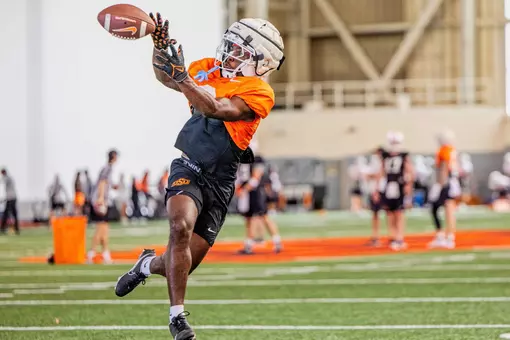
Receiver James Washington led the team with 1,087 receiving yards and 10 touchdowns. He and Marcell Ateman (45 catches for 766 yards and five touchdowns) were Rudolph's favorite targets on the perimeter and shifty slot man David Glidden (57 catches for 866 yards and three touchdowns) led the team in receptions. On third down plays, where some teams fall into the trap of forcing the ball to their go-to receiver, the Cowboys maintained balance, as Glidden was targeted 28 times, Ateman was targeted 27 times and Washington was targeted 24 times. All told, OSU had six different players catch 20 passes or more and had eight players with at least 200 receiving yards.
So while Oklahoma State was not a team built on the back of a single star, it was a team with great chemistry and resilience that was able to overcome its own flaws to exceed expectations.
STILLWATER - Oklahoma State was unranked in both the Associated Press and coaches polls to start the season, yet climbed to as high as No. 4 in the national rankings before settling in at No. 19 in the final A.P. poll.
The Cowboys were picked to finish fourth in the Big 12 in the preseason, yet played for the outright conference title on the final day of the regular season, eventually taking second in the league and securing the Big 12's berth to the Sugar Bowl.
Off the field, OSU set a program record by placing 22 players on the Academic All-Big 12 team.
So put simply, the Cowboys of 2015 exceeded expectations and even made history in matching a single-season school record by winning 10 games in a row.
The Cowboys finished 10-3 overall and 7-2 in the Big 12, and for the fourth time in the last seven seasons, played in a bowl game now referred to as one of the New Year's Six. OSU beat five teams who played in bowl games.
Perhaps more interesting than the team's final record was the path that the Pokes of 2015 took to get there. Coach Mike Gundy's bunch was not a particularly dominant team, but rather, one that found ways to win close games, which added up and added up to the Cowboys eventually posting their fourth 10-win season this decade. Only Alabama, Clemson, Florida State, Michigan State, Ohio State, Oklahoma, Oregon and Stanford have more 10-win seasons among Power Five conference schools since 2010.
The identity of the 2015 team was in its team chemistry, resilience and its ability to overcome its own flaws.
Three times during the course of the 2015 season did OSU erase a deficit of at least 15 points to win a game and the Pokes were 4-0 in games decided by one score. The Cowboys became the first team in Big 12 history to achieve a top-two finish in the conference standings despite averaging less than 130 rushing yards per game and not having a 750-yard rusher.
While struggles in the run game were a theme of the season, the Cowboys were able to make up for it thanks largely to remarkable play from the quarterback position, an overwhelmingly positive turnover margin and a disruptive defense.
Gundy broke from convention to employ a unique two-quarterback system throughout the season that was abnormally effective. Sophomore Mason Rudolph was the lead figure and finished the season ranked second in the Big 12 and 17th nationally with 3,770 passing yards. All of his key season metrics from 2015 rank among the best single-season marks in school history. The second half of the two-quarterback system was senior J.W. Walsh, who finished the season ranked 36th nationally by being responsible for 156 points. Making that statistic particularly impressive is the fact that he did it on 162 total offense attempts (rushes plus passes). Walsh's 0.92 points per total offense attempt led the nation. For perspective on that, the next highest finisher from a Power Five conference was Stanford's Kevin Hogan at 0.52 points per total offense attempt, meaning Walsh nearly doubled the production of the next closest Power Five competitor.
The execution of the two-quarterback system looked like this – Rudolph was the starter and central figure in most situations, but Walsh came on primarily in short yardage and goal line situations to give the Cowboy offense a different dimension. For the season, Walsh led the team in both rushes that resulted in first downs and touchdown rushes. If opposing defenses loaded up to stop the run with Walsh on the field, then he was an effective enough passer to finish the season with 13 touchdown passes against just one interception.
While Walsh's efficiency in short yardage situations was outstanding, Rudolph's efficiency in long yardage plays and ability to come through in difficult situations was also a key factor in OSU keeping drives alive. Put it this way – Rudolph attempted 107 passes on third-down plays. Of those 107 attempts, a whopping 95 came in third and long situations (seven yards or more). Of those 95 third-and-long situations, Rudolph completed 55 percent of his passes and converted 41 into first downs despite facing defenses who knew he had no option but to throw the ball down field.
In addition to strong quarterback play, another key to the Cowboys' ability to win games was the fact that OSU won the turnover battle more often than not. The Pokes led the Big 12 and ranked fourth nationally by holding a +1.00 advantage in turnovers per game.
Entering the year, defensive coordinator Glenn Spencer implemented a culture that revolved around the importance of forcing turnovers and established "We're taking it back" as the primary slogan for the Cowboy defense. The Pokes carried out his strategy remarkably well, evidenced by the fact that the Cowboys forced 28 turnovers on the year, a mark that ranked second in the Big 12 and was ninth nationally. OSU's defense scored five touchdowns on the season, a mark that led the Big 12 and was third nationally.
While the defense's knack for forcing turnovers was crucial, the offense was also to be praised for its ball security, as the Cowboys lost only 15 turnovers all season – a mark that ranked second in the Big 12 and 17th in the country. OSU lost just five fumbles all season to rank ninth in the nation.
Perhaps the most telling statistic about the importance of turnovers for the Cowboys of 2015 is this: in the first 10 games of the season (all wins), OSU forced an average of 2.4 turnovers per game, which led to the Cowboys holding an overwhelming 107-31 advantage over their opponents in points off turnovers. In the final three games of the season (all losses), the Cowboys forced 1.3 turnovers per game and lost the points off turnovers battle, 16-7.
The ability to force turnovers was a central trait of the OSU defense in 2015 and was borne largely from the disruption that the Cowboys were able to create up front. In first-team All-American and Big 12 Co-Defensive Player of the Year Emmanuel Ogbah, the Cowboys had the most dominant defensive player in the league. Ogbah finished the season as the Big 12 leader in sacks and he was second in the conference in tackles for loss. He set a single-season school record with 19 quarterback hurries, forced three fumbles, recovered two, scored a defensive touchdown and broke up four passes at the line of scrimmage. Three times during the season was Ogbah honored as the national defensive player of the week and three times was he the Big 12 defensive player of the week.
Ogbah was the most decorated member of the team, but he was not the only one to secure individual accolades, as safety Jordan Sterns, cornerback Kevin Peterson, linebacker Jordan Burton and Cowboy Back Blake Jarwin earned first-team All-Big 12 honors from either the Associated Press or by the coaches.
Playing Cowboy Back (a hybrid fullback/tight end position in the OSU offense), Jarwin illustrates an interesting point about the Cowboy offense. OSU finished the season averaging 39.5 points per game and ranked in the top 10 nationally in both passing offense and red zone offense despite not having a productive running game and just one first-team All-Big 12 offensive player – Jarwin – who caught 17 passes and averaged 18.2 receiving yards per game.
So how did the Cowboy offense put up the numbers it did despite lacking a clear star? With balance in the passing game.
Receiver James Washington led the team with 1,087 receiving yards and 10 touchdowns. He and Marcell Ateman (45 catches for 766 yards and five touchdowns) were Rudolph's favorite targets on the perimeter and shifty slot man David Glidden (57 catches for 866 yards and three touchdowns) led the team in receptions. On third down plays, where some teams fall into the trap of forcing the ball to their go-to receiver, the Cowboys maintained balance, as Glidden was targeted 28 times, Ateman was targeted 27 times and Washington was targeted 24 times. All told, OSU had six different players catch 20 passes or more and had eight players with at least 200 receiving yards.
So while Oklahoma State was not a team built on the back of a single star, it was a team with great chemistry and resilience that was able to overcome its own flaws to exceed expectations.
Players Mentioned

WR
/ Cowboy Football
LB
/ Cowboy Football
WR
/ Cowboy Football
CW
/ Cowboy Football
DE
/ Cowboy Football
CB
/ Cowboy Football
QB
/ Cowboy Football
S
/ Cowboy Football
QB
/ Cowboy Football
WR
/ Cowboy FootballFriday, June 05
Friday, May 29
Wednesday, May 27
Monday, May 18