Oklahoma State University Athletics
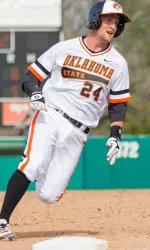
McCurry's Long Journey Of Success
May 22, 2013 | Cowboy Baseball
May 22, 2013
By Kelli Grashell, OSU Media Relations
It's becoming clear in baseball today that many pitchers will undergo Tommy John surgery at some point in their career. Some pitchers come back to the mound at full force, while others don't return to the game at all.
But for Oklahoma State's Randy McCurry, the story is a bit different.
As a freshman in 2009, McCurry established himself as the Cowboys' closer. In 28 appearances as a freshman, he tied the program's single-season saves record with 10, a total that ranked third in the Big 12 that season. He also had a team-best 2.16 ERA and a 4-1 record.
Based on that success, the National Collegiate Baseball Writers Association listed him as one of 40 players on the Stopper of the Year Watch List before the start of the 2010 season. And in the '10 season opener, he was called out of the bullpen and started the same warm-up routine he goes through before every appearance. However, one of his warm-up pitches became quite the game changer for McCurry.
“I was in the bullpen warming up, and everything felt fine,” McCurry said. “Then I went into the game and on the first warm-up pitch my elbow popped.”
Two weeks later, McCurry underwent Tommy John surgery. Tommy John surgery, known in medical practice as ulnar collateral ligament (UCL) reconstruction, is a surgical graft procedure in which the ulnar collateral ligament in the medial elbow is replaced with a tendon from elsewhere in the body.
This procedure is common among collegiate and professional athletes in several sports, most notably baseball. Several well-known pitchers in Major League Baseball have undergone the surgery such as Tim Hudson, Adam Wainwright, Stephen Strasburg and other standout hurlers.
“I think the biggest thing you see happen is guys getting injured and being forced to take care better care of themselves to come back,” said OSU head coach Josh Holliday. “Sometimes, in the injury process, they're exposed to more training so they're more serious about their training, they train differently and they spend a whole lot more time taking care of themselves in the rehab process. A lot of times, this can lead to something different when they come back.”
In some cases, some pitchers find themselves throwing harder than they did before. Many factors could cause this to happen, such as increased conditioning in the rehabilitation process, allowing pitchers to pay more attention to training their arm. Another reason is that the UCL takes many years to deteriorate, causing the pitcher's velocity to decrease at the same rate.
“My velocity decreased because I rushed it back,” McCurry said. “I was back pitching at eight months, when it's supposed to be 12-15 months. Now, my arm is stronger than it has been ever since the surgery. It just feels like it keeps getting stronger so if I keep working on it, maybe the velocity will come back.”
McCurry said the first two years coming back were pretty rough. His younger brother, current OSU closer Brendan McCurry, knows how difficult it was for him.
“It was tough because when he hurt it he was throwing 98-99 (mph) and throwing really hard. Now after the surgery, he is not anywhere near that, and it was just really tough on him because he was so good then,” Brendan McCurry said.
Many other current Cowboys have undergone Tommy John surgery including Jason Hursh, Mark Robinette, Phillip Wilson and Rick Stover. With such a large number of players having experienced this injury and the number sure to grow, Coach Holliday and his staff work daily to take preventative measures.
“Our staff came on and inherited a lot of injured arms. Our first priority was to get them all healthy,” Holliday said. “I think we've spent a lot of time and invested a lot of money in the training equipment and expertise required to take care of our players. It's something that's very high on (OSU pitching) coach (Rob) Walton's list of priorities, as it is mine. We condition them properly, we take care of them and we give them everything they need to be healthy and stay on the field so they can develop.”
McCurry returned to action for the Cowboys in 2011, seeing action in 14 games at second base, shortstop, outfield and DH. He made 18 appearances on the mound, four of those as the starter, and showcased some of his pre-surgery skills by tossing 4.2 scoreless innings against Texas and recording a career-best seven strikeouts in four innings against Nebraska.
In 2012, McCurry was a double threat at the plate and on the mound and earned All-Big 12 Second Team honors as a utility player. McCurry played in 25 games and appeared in 15 games as a pitcher, starting 12. He had six multi-hit games, turned in a season-high three RBI against Kansas State and was 5-for-12 with five RBI in the K-State series. On the mound, he recorded a career-high 12 strikeouts in an eight-inning effort against Texas A&M, allowing only one walk and one earned run against the Aggies. He appeared in five Big 12 games and had 1.89 ERA and 23 strikeouts in 19 innings.
And McCurry's evolution as a two-way play has evolved even further in 2013. While it is somewhat uncommon in baseball to have a player switch from pitcher to infielder, McCurry has done just that as a fifth-year senior. With a lack of infielders on the OSU roster, McCurry was needed as a two-way player, and he definitely has delivered.
In 2013, he has taken on the role of OSU's starting shortstop while also occasionally working on the mound. Earlier this year, he was listed as one of 25 players on the John Olerud Two-Way Player of the Year award watch list, and he earned All-Big 12 Second Team honors as a utility player for the second-straight season.
“Offensively, for a guy who had maybe 50 at bats in his college career before this year, he's developed quite well,” Holliday said. “He's played extremely well at shortstop, which is also a real compliment to him and the way he's developed since he got here because that's not an easy position to play. Offensively and defensively, we wouldn't be where we are at had he not emerged into a guy that we could count on.”
A .321 hitter with a Big 12-best 20 doubles who is also 2-1 with a save, McCurry has played a key role on an OSU team that finished second in the conference standings and ended the regular season with the best overall record in the league and the Cowboys' best since 2008.
“(McCurry) leads through consistency. He shows up every day, he works hard and brings a good demeanor to the ballpark every day,” Holliday said. “I think Randy has been a huge part to our success, and I think that's a compliment to how much he's grown up since he's got here.”
After a difficult journey with years of conditioning, one might ask what motivates him to continue. Like any great player, McCurry has one simple reason.
“Love of the game,” McCurry said. “I just wanted to come back and play.”

![Image Taken at [event name], [day], [month date], [year], [venue], [city]. Brayden Hartmann/OSU Athletics](https://images.sidearmdev.com/resize?url=https%3A%2F%2Fdxbhsrqyrr690.cloudfront.net%2Fsidearm.nextgen.sites%2Fokstate.com%2Fimages%2F2026%2F4%2F20%2FConover_celebration_vs._Kansas.jpg&height=340&type=webp)