Oklahoma State University Athletics
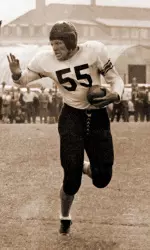
Remembering a Cowboy Legend
September 08, 2010 | Cowboy Football
Sept. 8, 2010
At the end of July, the Cowboy football program lost one of its most legendary players.
On July 28, 2010, former Oklahoma State football star and Woodward native Bob Fenimore passed away in Stillwater at the age of 84 after a two-year battle with cancer. He is survived by his wife Veta Jo and his two daughters, Beth Atess and Jo Ellen Jones, who all live in Stillwater.
Fenimore played in Stillwater in the mid-1940s, when the school was still known as Oklahoma A&M and the team was known as the Aggies. He helped the Aggies to some of the best football seasons in school history, including an 8-1 campaign in 1944 that ended with a Cotton Bowl victory and a 9-0 season the following year in which the Aggies finished with a win in the Sugar Bowl. The 1945 season is the only undefeated season in OSU history.
The best player on those teams was undoubtedly Fenimore. Not only was he the school's first All-American in football, he was also the first two-time All-American, receiving the honor as a sophomore in 1945 and again as a junior in 1946.
Known as the “Blond Bomber,” Fenimore set the tone for a running back tradition that continues to this day. Fenimore was the first in a line of record-setting running backs including Terry Miller, Thurman Thomas, Barry Sanders, Tatum Bell, Kendall Hunter, Gerald Hudson and Ernest Anderson.
Even though he played only eight or nine games a season, as opposed to 11, 12 or 13 the other great backs played in, Fenimore's name still litters the OSU record book.
Hunter passed Fenimore on the career rushing yard list last season, putting Fenimore at No. 12 with 2,299 yards. His junior year total of 1,048 yards is 17th most in a season. He rushed for 241 yards against Arkansas that year which is No. 15 for most rushing yards in a game in school history.
His best friend and former teammate Neill Armstrong, who was the team's second All-American in 1946 as a receiver and defensive end, called Fenimore one of the best running backs he's ever seen.
“He was a great player,” Armstrong said. “He could run; he had great speed for a guy back in those days. He ran about a 9.7 (second) 100-yard dash, and he was about 195 pounds.
“So he was about a good a runner as I've ever seen in college football.”
What made him such a special player went well beyond his running ability. He was also the Aggies' leading passer. He is 11th all-time at OSU with 2,315 passing yards.
His rushing and passing yards helped him to lead the nation in total offense with 1,758 yards in 1944 and again in 1945 with 1,641 yards. He is sixth all-time on OSU's career total offense list with 4,627 yards.
In Fenimore's playing days, it was common for players to play on both sides of the ball, and he was no exception. As a safety, Fenimore intercepted 18 passes in his career, which still stands as the most in OSU history, and he also served as the team's punter. He was inducted into the College Football Hall of Fame in 1972 and the Cotton Bowl Hall of Fame in 2007.
But it wasn't Fenimore's athletic prowess that made Armstrong want to befriend him; it was his personality. Fenimore and Armstrong both came to Stillwater in 1943 at 17-years-old. They quickly became friends as well as two of the most important players on the team.
“He was just such a good person and good young man, and we just kind of hit it off,” Armstrong said. “We both took some of the same classes; we were both in the College of Education so we got to be pals.”
Larry Reece, OSU's Senior Director of Major Gifts and public address announcer, became close friends with Fenimore during the past 15 years. Reece echoed Armstrong's opinions
about the type of man that Fenimore was.
“Not only was he a great player, he was an even greater person,” Reece said. “He was a humble person, a gentleman and he was willing to talk to anyone.
“If you didn't know who he was and you just met him on the street, you would just think he was the nicest guy in the world and you probably wouldn't find out from him that he
was such a great football player and meant so much to OSU because he wouldn't want to talk about himself. He'd want to talk about you and what was going on in your life.”
Fenimore's senior season was marred by injuries, but the Chicago Bears drafted him with the first pick of the 1947 NFL Draft. He only played one season, after which he moved back to Oklahoma because he could make more money selling insurance.
Reece said Fenimore was an outstanding citizen in the Stillwater community and supported his university throughout his life.
“I like to say he was a supporter of all things Cowboys. He loved his Cowboys and watched every game on TV or came to the games when he could,” Reece said. “That's all we ever talked about. He was always up to speed on what was happening with the current Cowboys.”
Fenimore married his high school sweet heart, Veta Jo, and they remained married for 63 years until his death. Armstrong said he and his wife were good friends with the Fenimore family throughout the years.
“Bob was one of those people who was never a stranger and was just a good person. They don't come any better,” Armstrong said.
Fenimore's and Armstrong's friendship is memorialized in Heritage Hall on the Oklahoma State campus. Inside a display case amidst other football memorabilia of the era is
a photograph of Fenimore and Armstrong shaking hands. They exchanged a ceremonial handshake before each game.
Armstrong couldn't recall who started the handshake because “it's been too many years.” He also said he has the picture hanging up in his office.
“We always shook hands before the kickoff,” Armstrong said. “I also kicked off and Bob held on the kickoff. Back in those days, you didn't set (the football) up on a tee, you just kicked it off the grass so you had to have someone hold it for you and Bob did that.
“And when we received the ball, we shook hands. That was just a special friendship you have with a teammate.”
During the 2010 football season, the OSU players will be wearing a decal in honor of Fenimore. The sticker that will go on the helmets is an orange 55, Fenimore's uniform number, outlined in black. In between the two fives will be a silhouette of a kneeling cowboy to signify that an OSU Cowboy has been lost.
“Bob is gone, but not forgotten. It's an old saying, and it's certainly true of him,” Armstrong said.