Oklahoma State University Athletics
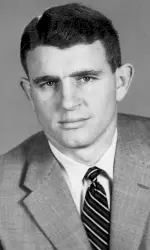
Armstrong's Name Etched In OSU Lore
September 22, 2010 | Cowboy Football
Sept. 22, 2010
Looking Back With Pat Quinn
Whenever conversation about Oklahoma State football gets cranked up, especially since the turn of the century, one point most often agreed upon was the foundation of the grid sport started with a bang in the mid 1940's.
The talk centers on tailback Bob Fenimore and his slender right end, Neill Armstrong. Fenimore, from Woodward, and Armstrong, a native of Tishomingo, both became All-Americans in those halcyon days of Cowpoke football.
Of course, both lettered four years in football and track, with the latter sport producing one of the most unbelievable occurrences in OSU (Oklahoma A&M) athletic history.
Armstrong was a hurdler and ran on all of the relay teams, while Fenimore was a sprinter and he, too, extended his talents to relays. But, most important was their friendship, a closeness that lasted well over a half century.
Talking with Armstrong is a pleasant experience, and he and Fenimore were part of a six-man traveling squad that stunned West Point in a dual track meet and even produced an Armstrong hurdle win over Olympian Harrison Dillard in the Penn Relays a few days later.
Armstrong immediately downplays the win over Dillard, by adding with a laugh, “Dillard was a famous hurdler, and the reason I beat him that day was he fell down early in the race.
“Ralph Tate won the hurdle race, and I think I was third, at best.”
But the big event started a few days earlier than the well-known Penn Relays when Armstrong, Fenimore, Ralph Tate, Noel Due, J.R. Teakell and Cecil Hankins pulled off a dual track win over Army on the banks of the Hudson River.
Dual meets in track and field were the “thing” in the l940's, but the strongest track squads usually included a dozen to 20 competitors, not a measly half-dozen young lads from a distant land grant college on the plains of Oklahoma.
Armstrong and Fenimore, both collegiate football All-Americans, were the closest of friends. OSU assistant football coach Jack Baker hung the nickname of “Felix the Cat” on Armstrong and Fenimore jokingly called him “Bird.”
“Fenimore called me 'Bird' because I had long, skinny legs,” Armstrong laughs, then adds, “When your football team and fraternity brothers hang a name like that on you, you go a long time before they forget it.”
Armstrong cherishes his days at OSU, then, of course, named Oklahoma A&M. When asked whether the fun days outnumbered the bad, Armstrong quickly retorts, “Fun? Oh, yes. There were about 2,500 students then and most were related to the Army and Navy programs we had on campus.
“Most of them were civilians,” Armstrong corrected and laughingly added, “The majority of the students were girls.
“As I remember, there was about three girls for every guy on campus, and I'm sure you'd consider those enjoyable odds.”
Armstrong lettered all four years in football, playing an integral role in Cotton Bowl (1944) and Sugar Bowl (1945) victories along the way, and he became the first OSU product to play in the 1946 Blue-Gray Game that involved the best collegians in the nation.
His name is sprinkled through the Cowboy record book, with one of his more memorable efforts a nine reception-outing in the 1944 game with the Norman Navy Zoomers, a military team chocked with All-Americans and later standouts in the National Football League. Armstrong also led the Cowboys in receptions in three of the four years he won football monograms at the rapidly growing university in Stillwater.
Armstrong was a first round draft choice of the Philadelphia Eagles in 1947 and played for that franchise through 1951.
He returned to OSU as an assistant football coach from1955 through 1961. Further coaching ventures included being the head coach of the NFL's Chicago Bears from 1978 through 1981 and that followed a successful tour of coaching in the Canadian Football League.
“My wife (Jane) and I have always enjoyed trips back to Stillwater and OSU,” Armstrong concludes. “And we've both marveled at the amazing improvements in the field house and Boone Pickens Stadium.
“It's so much larger and better than when we were in school, but there are enough of the old things remaining that bring back the best of our college day memories.”
Pat Quinn worked in the Oklahoma State Sports Information Office for 26 years, including serving as the director from 1969-1984.