Oklahoma State University Athletics
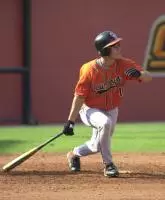
Rockies Consider Former Cowboy Jeff Salazar Elite
June 15, 2004 | Cowboy Baseball
Originally Appearing in
The Rockies don't care whether anyone else considers Jeff Salazar an elite prospect or not.
They do. And they have a hard time containing how highly they regard the Class A Visalia center fielder, whom farm director Bill Geivett calls "a tremendously gifted player."
Salazar is enjoying his second consecutive strong season, getting off to a .326-11-36 start for the Oaks. He has 13 stolen bases in 14 chances, boasts a sterling 27-24 strikeout-walk ratio, and leads the California League in runs (59) thanks in part to robust slugging (.558) and on-base (.395) percentages.
"He doesn't fit the profile of an elite player, until you watch him for four or five days in a row," assistant farm director Billy Eppler said. "Then you start to just love him."
Salazar's profile looks like that of an organizational player. A 6-foot, 180-pounder, he was an eighth-round pick in 2002 out of Oklahoma State, where he played only one season. He was lightly recruited out of high school and ended up at Connors State (Okla.) JC.
"I wasn't even signed with a junior college when I graduated high school," Salazar said. "Connors State didn't come around until I was all-city (in Oklahoma City). I guess it's because I didn't even weigh 170 back then."
The Orioles saw something and drafted him in the 35th round as a draft-and-follow in 2000 but didn't sign him, and Salazar went on to Oklahoma State, where he hit .329-4-42 with 23 stolen bases in his lone season. After being drafted by the Rockies, he signed quickly and hit .235-4-21 for short-season Tri-City in his pro debut, drawing 47 walks for a .351 on-base percentage.
It was an ordinary beginning to what could have been an ordinary career. But Salazar has proved to be far from ordinary, showing tremendous aptitude and a willingness to improve.
"We have a system of hard workers," Geivett said, "but he is one of the hardest-working guys in the system."
The physical package doesn't look enticing at first glance, but as Eppler said, Salazar's tools become apparent soon enough. He always has run well and consistently gets to first base in 4.1 seconds, making him a 60 runner on the scouting 20-to-80 scale. The Rockies want him to focus on the short game and be a table-setter, but Salazar wanted that and more last year at Class A Asheville.
"I wasn't hitting much in the first months of the season (.267) when something clicked," Salazar said. "I put in a leg kick in my stride, just trying to help myself stay back. It kind of came out of nowhere; it just evolved. You know who Sadaharu Oh is? It's kind of like that."
And sort of like the Japanese home run king, Salazar started hitting for power. He hit .361 last June and slammed 20 homers in his final 314 at-bats for the Tourists, finishing with .284-29-98 numbers. He also walked (77) more than he struck out (74) and swiped 28 bases in 42 tries, narrowly missing a 30-30 season.
"He hit a lot of home runs last season, but that's now how we view him," Geivett said. "We'd like for him to be a leadoff guy. He's a good runner. But he's going to be a leadoff guy with some power, because he drives the ball with impact."
Salazar seems to do everything with impact now. Eppler fairly gushes when discussing his tools, grading Salazar as above-average for the hitting, running (4.1 seconds or less to first base) and fielding tools, while rating his power and arm as average.
"You can project a six on him for power if you consider 20-25 home runs to be above-average," Eppler said. "I think it's not out of the question for him to hit 15-20 home runs in the big leagues. He knows the strike zone, he knows his swing and he has bat speed."
And Geivett said Salazar's arm strength might be just average, but as a tool his arm might jump a grade because of his excellent accuracy.
In other words, Salazar looks like an average player at first glance. A closer look, though, reveals an elite prospect, one who should move quickly through the Rockies system. The Oklahoma native said he would love to be able to play at Double-A Tulsa in front of friends and family from his Oklahoma City home, but club officials make it sound like he may not be in the minors much longer.
"He can play defense in the big leagues right now," Geivett said. "We really feel like when he gets to the point of using the whole field consistently at the plate, and when he gets better with his bunting, he's going to be a complete offensive player.
"He hasn't hit any speed bumps yet, and I really think he's going to be the kind of player who doesn't hit too many."