Oklahoma State University Athletics
A Century of Cowboy Wrestling: 1950s
October 01, 2015 | Cowboy Wrestling
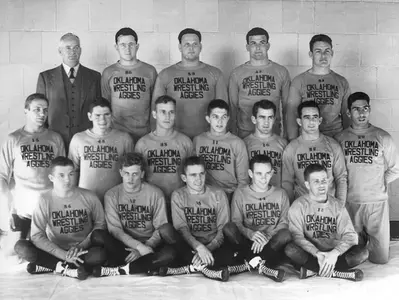
With Art Griffith cemented as its coach, Oklahoma A&M looked to carry its 1940s success into the 1950s.
In 1949, Dick Hutton lost in the national finals to Verne Gagne due to a controversial referee's decision - a decision which cost him his third-straight national title. But in 1950, Hutton returned as the leader of an Oklahoma A&M team looking to win its third-consecutive team title.
The Cowboys finished the regular season undefeated and extended the longest winning streak in school history to 75 consecutive duals.
At the NCAA Championships, Hutton reached the finals for a record fourth time, where he won his third individual national championship. He finished his career at Oklahoma A&M with only one defeat and holds the sixth-best winning percentage in program history at 96.59 percent.
While Hutton found success at the 1950 NCAA Championships, his team didn't fare quite as well.
Hutton and Byron Todd, who placed third at 147 pounds, were the only two wrestlers to receive All-America honors. The lack of individual success led to Oklahoma A&M finishing fourth in the team standings – its lowest finish since the NCAA Championships were introduced in 1928.
In 1951, the Cowboys defeated Nebraska in the season's opening dual to extend their winning streak to 76. They then traveled to Oklahoma for the second dual of the season.
With 1,500 fans in attendance, the Sooners upset Oklahoma A&M, 19-8. The loss marked the end of the Cowboys' nearly 14-year winning streak as well as the first loss in Coach Griffith's Oklahoma A&M career.
The 76-dual winning streak still ranks as the longest such streak in program history.
Later in the 1951 season, Oklahoma A&M once again lost to its in-state rival, marking just the second multiple-loss season in program history. At the NCAA Tournament, the Cowboys finished second in the team standings.
It was the first time the Cowboys failed to win a national title in consecutive years.
The national championship drought continued for two more seasons as the Cowboys placed third in 1952 and fourth in 1953.
Before placing fourth at the 1953 NCAAs, Oklahoma A&M finished the regular season with a dual record of 3-3 – the Cowboys' first non-winning record since 1916, the program's second season.
In 1954, the Cowboys posted a perfect 7-0 record in regular season duals and won their first national title in five years. Coach Griffith's team had six wrestlers receive All-America honors, including three individual champions.
Oklahoma A&M followed up the 1954 national championship with two more titles in 1955 and 1956. But after the 1956 season, the Cowboys entered a new era as Griffith decided to retire from coaching.
Griffith won eight NCAA Championships in his 13 seasons. His wrestlers won 27 individual championships and received All-America honors 64 times.
He retired on top after winning three-consecutive national championships and finished with a record of 78-7-4 for his career, which included 10 undefeated teams. Griffith was honored as a Distinguished Member of the National Wrestling Hall of Fame's inaugural class in 1976.
Griffith was succeeded at Oklahoma A&M by one of his own wrestlers - Myron Roderick.
Roderick won 42 of 44 matches in his three years as a wrestler at Oklahoma A&M, including three individual national championships (1954-56). He also placed fourth in the 1956 Olympic Games at Melbourne, Australia, losing a split decision to the eventual champion.
After he returned from the 1956 Olympics, Roderick took over as head coach.
Going from national champion in 1956 to the new torch-bearer of Oklahoma A&M wrestling program in 1957 was a sudden, but highly successful, transition.
Roderick led the Cowboys to the NCAA team title in his second season and became, at 23, the youngest coach ever to guide a national champion team in any sport.
That year was also the first time that the newly-renamed Oklahoma State competed in a conference tournament since 1928. The Cowboys tied for second in their inaugural Big Eight conference tournament.
The following season, OSU lost just one regular season dual, to rival OU, as the Cowboys won their second-consecutive national championship and the school's first conference championship since 1928.
OSU's 1959 loss to OU marked the end of the Cowboys' two-year unbeaten streak, but the victory over Iowa in the following dual was the beginning of yet another record-setting streak as the program headed into the 1960s.
During the 1950s, OSU won five national championships, 17 individual national championships, including 47 All-Americans, and posted a team record of 59-10-8.
In 1949, Dick Hutton lost in the national finals to Verne Gagne due to a controversial referee's decision - a decision which cost him his third-straight national title. But in 1950, Hutton returned as the leader of an Oklahoma A&M team looking to win its third-consecutive team title.
The Cowboys finished the regular season undefeated and extended the longest winning streak in school history to 75 consecutive duals.
At the NCAA Championships, Hutton reached the finals for a record fourth time, where he won his third individual national championship. He finished his career at Oklahoma A&M with only one defeat and holds the sixth-best winning percentage in program history at 96.59 percent.
While Hutton found success at the 1950 NCAA Championships, his team didn't fare quite as well.
Hutton and Byron Todd, who placed third at 147 pounds, were the only two wrestlers to receive All-America honors. The lack of individual success led to Oklahoma A&M finishing fourth in the team standings – its lowest finish since the NCAA Championships were introduced in 1928.
In 1951, the Cowboys defeated Nebraska in the season's opening dual to extend their winning streak to 76. They then traveled to Oklahoma for the second dual of the season.
With 1,500 fans in attendance, the Sooners upset Oklahoma A&M, 19-8. The loss marked the end of the Cowboys' nearly 14-year winning streak as well as the first loss in Coach Griffith's Oklahoma A&M career.
The 76-dual winning streak still ranks as the longest such streak in program history.
Later in the 1951 season, Oklahoma A&M once again lost to its in-state rival, marking just the second multiple-loss season in program history. At the NCAA Tournament, the Cowboys finished second in the team standings.
It was the first time the Cowboys failed to win a national title in consecutive years.
The national championship drought continued for two more seasons as the Cowboys placed third in 1952 and fourth in 1953.
Before placing fourth at the 1953 NCAAs, Oklahoma A&M finished the regular season with a dual record of 3-3 – the Cowboys' first non-winning record since 1916, the program's second season.
In 1954, the Cowboys posted a perfect 7-0 record in regular season duals and won their first national title in five years. Coach Griffith's team had six wrestlers receive All-America honors, including three individual champions.
Oklahoma A&M followed up the 1954 national championship with two more titles in 1955 and 1956. But after the 1956 season, the Cowboys entered a new era as Griffith decided to retire from coaching.
Griffith won eight NCAA Championships in his 13 seasons. His wrestlers won 27 individual championships and received All-America honors 64 times.
He retired on top after winning three-consecutive national championships and finished with a record of 78-7-4 for his career, which included 10 undefeated teams. Griffith was honored as a Distinguished Member of the National Wrestling Hall of Fame's inaugural class in 1976.
Griffith was succeeded at Oklahoma A&M by one of his own wrestlers - Myron Roderick.
Roderick won 42 of 44 matches in his three years as a wrestler at Oklahoma A&M, including three individual national championships (1954-56). He also placed fourth in the 1956 Olympic Games at Melbourne, Australia, losing a split decision to the eventual champion.
After he returned from the 1956 Olympics, Roderick took over as head coach.
Going from national champion in 1956 to the new torch-bearer of Oklahoma A&M wrestling program in 1957 was a sudden, but highly successful, transition.
Roderick led the Cowboys to the NCAA team title in his second season and became, at 23, the youngest coach ever to guide a national champion team in any sport.
That year was also the first time that the newly-renamed Oklahoma State competed in a conference tournament since 1928. The Cowboys tied for second in their inaugural Big Eight conference tournament.
The following season, OSU lost just one regular season dual, to rival OU, as the Cowboys won their second-consecutive national championship and the school's first conference championship since 1928.
OSU's 1959 loss to OU marked the end of the Cowboys' two-year unbeaten streak, but the victory over Iowa in the following dual was the beginning of yet another record-setting streak as the program headed into the 1960s.
During the 1950s, OSU won five national championships, 17 individual national championships, including 47 All-Americans, and posted a team record of 59-10-8.
Friday, June 05
Friday, May 29
Wednesday, May 27
Monday, May 18