Oklahoma State University Athletics
Facilities
April 16, 2009 | General
Gallagher-Iba Arena
Since its dedication in 1938, the home of Oklahoma State Basketball and Wrestling has been Historic Gallagher-Iba Arena, but the venerable fieldhouse has a vastly new look. The arena still provides an up-close view from any seat in the house, helping to give the Cowboys and Cowgirls a tremendous home-court advantage, but it has been doubled in size and modernized in appearance.
The historic building has undergone a massive $55 million construction project and is part of the OSU Athletics Center. Its 13,611-seat capacity allows more O-State fans to enjoy OSU athletics events, and the auxiliary facilities are second to none in the region.
Originally named Gallagher Hall after OSU fabled wrestling coach Ed Gallagher, the Board of Regents honored legendary Cowboy basketball coach Henry Iba when the arena was remodeled in 1987, and his name was added to the arena title.
Gallagher served as OSU wrestling coach from 1916-40. In his 23 years, OSU won 11 national team titles and compiled a 138-5-4 dual record. Gallagher was also an outstanding athlete while attending Oklahoma State. He was captain of the track team for three years, and his 99-yard run against Kansas State in 1908 will always stand as the longest football run in school history.
Iba, who passed away in January of 1993, was a coaching giant in the sport of basketball. He coached in 1,105 collegiate games, and his 767 career wins were fourth only to Dean Smith, Adolph Rupp and Jim Phelan. Iba served as coach and athletic director at OSU from 1935 to 70, and in those 36 seasons, posted a 655-316 record while guiding the Cowboys to 13 league championships, eight NCAA appearances and the 1945 and 1946 NCAA Championships.
Along with the expansion of the historic arena, the OSU Athletics Center has many features. A total of 14 luxury suites stretch across the west side of the facility, overlooking both the basketball court and the football field. Banners signifying the success of Oklahoma State Athletics are hung from the rafters. The pride of OSU athletic triumphs are also illustrated in photographic and trophy displays in Heritage Hall.
Even after two major construction projects, today's players still compete on the gym's original white maple floor, which was the country's most expensive when it was installed in 1938. The arena was built in 1938 at a cost of $1.5 million. National powers Oklahoma State and Kansas opened the facility on Dec. 9 in a game that matched coaching legends Henry Iba and Phog Allen. OSU won that game, 21-15.
The home record for Cowboy Basketball on the original 1938 white maple court, which remains in place to this day, has been nothing short of impressive. Through the first 64 years in the building, the Cowboys posted a 593-177 record at home with nine undefeated seasons. In addition, the Cowboys' 80-game homecourt non-conference winning streak, which ran from 1986 to 1998, ranks fifth in NCAA Division I history.
|
Built over a 10-year period, the Kaye Barrett Droke Track and Field Center contains many admirable features. The track originally opened at the end of May 1972. It was oval in shape and a quarter of a mile long. Eight running lanes were originally available.
In the spring of 1973, the university placed a storage shed near the track so the equipment could be kept near for use. An on-site building was the next article of business for the university. Kaye Barrett Droke helped finance the project with donations and a building bearing his name, was built containing varsity dressing rooms, training rooms, coaches' offices and spectator restrooms.
In 1981, Oklahoma State replaced the quarter mile track with a universally accepted 400-meter oval. At this point the inside of the track was made useable for field events including fenced in areas for shot, discus, high jump, triple jump and pole vaulting. Over the years, the surface has been replaced and since 1986, the track has been made of Versaturf, a polyurethane product. At this time, the track added a jogging lane to the eight running lanes. Since this point, several other luxuries have been added including bleachers with a seating capacity of 1,500, a press box and an automatic timing clock.
Cowgirl Soccer Complex - Cowgirl Corral
The Cowgirl Soccer Complex, also known as the Cowgirl Corral, was brought about through a series of stages along with the conception of the women's soccer program in 1996.
The Corral came into existence in 1996-97 when a sand-based playing field was created. The playing surface for the Cowgirls is a Bermuda Hybrid Tifway 419 grass that is often used on the premiere golf courses throughout the nation. The field is also designed to have an outstanding drainage system, ensuring that the Cowgirls can play shortly after even torrential downpours.
The field measures 115 X 75 yards and is well lit to accommodate night games throughout the season. In 2001, the additions of 1,000-seat bleachers to the east side of the field were put in place to accommodate the growing crowds at the Corral. The addition of these bleachers and the growing tradition of Cowgirl Soccer have helped OSU obtain a number four ranking in the Big 12 in average season attendance.
Many future facility upgrades are also in the works for Cowgirl Soccer, including locker rooms for the Cowgirls and opposing teams, concession areas, and spectator restrooms.
|
The Oklahoma State Equestrian team utilizes a number of areas for their practices and upkeep of their horses. The OSU Equine Center has a 50-acre farm located on the corner of McElroy and Western and a 120-acre pasture on Lakeview Road. The center cares for approximately 60 head of horses used for laboratory experiences in undergraduate classes, research programs and extension activities with the number of breeding horses recently being reduced to accommodate the increase in riding horses with the addition of the equestrian program.
The Equestrian team also utilizes the Animal Science Arena for their shows and for practices a couple of days a week. Animal Science Arena has seating on the north side of the arena and also has a small tack area along with a holding area for the horses on the days of the shows. In addition to the main area, the arena has a concession area as well as a classroom for teaching OSU classes.
In the fall of 2000, a new saddling barn and outdoor arena were built near the Animal Science Arena for the Equestrian program. The new saddling barn features a larger tack room, a locker room for the team members, and coaches' offices.
Conceived in the mind of one man and brought to life through the efforts of many over a period of 15 years, Karsten Creek now serves as a daily reminder of the commitment to excellence of the OSU golf program.
Karsten Creek was built for the OSU golf teams, and its purpose is to aid in the recruitment and development of future OSU stars. It was designed by Tom Fazio and in the May 1998 edition of Golf Digest, Karsten Creek was awarded its first five-star rating, making the course one of 10 in the nation to be so honored.
This splendid golf facility stretches over 7,100 yards with SR1020 bent-grass greens and zoysia fairways. All of the holes were carved from the native oak trees surrounding Lake Louise. Karsten Creek was so named to honor Karsten Solheim, the founder of Karsten Manufacturing, and Lake Louise honors his wife. Their support of OSU golf over the last 20 years has been instrumental in the success of the golf team.
Karsten Creek's surprising beauty is derived from an unsuspecting tract of land that is densely covered with black jack and pin oak trees and contains dramatic elevation changes that are not common to the heartland of America. It also has recently been ranked as the best college course in the country by Travel & Leisure Golf magazine.
In addition to the immaculate course, Karsten Creek's clubhouse was completed in June of 2001 at a cost of around $4.5 million. Its beautiful views of the golf course, warm cozy rooms, and intricate architectural woodwork bring the course to a new level of recognition.
Cowboy golf also boasts an elaborate practice facility that is second to none. Cowboy golfers are able to utilize a practice range which possesses tee boxes that surround the entire landing area to allow players to practice with any wind direction. The players' short-game area comes complete with three tee boxes to hit 40 to 80-yard shots and three putting greens with varied grass types, allowing players to prepare for a wide range of course types.
An indoor practice facility was also constructed in the fall of 1997 and is equipped with state-of-the-art video equipment for swing analysis.
Karsten Creek is truly a special place that allows Oklahoma State to continue its golf legacy.
Holes:
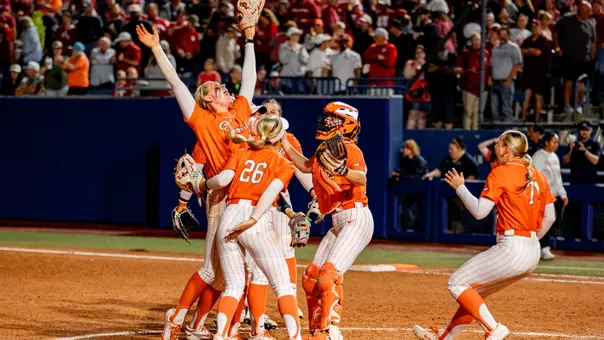
With the completion of the new Cowgirl Stadium in April of 2000, the Cowgirls now have one of the newest facilities in the Big 12 Conference for the sport of softball. The addition of this stadium is an integral part making the Oklahoma State softball tradition complete.
Built at a cost of approximately $2 million, the new stadium was built on the same site as Cowgirl Field, home of the Cowgirls for more than 20 years. Construction began on this state-of-the-art facility started on June 14, 1999. A majority of the funding for the new Cowgirl Softball Stadium was secured from Western Star, the title sponsor from the Oklahoma State football game versus Nebraska on October 3, 1998 at Arrowhead Stadium in Kansas City.
The Stadium includes 452 chair back seats in both orange and black. A patio area was also created above the Cowgirl dugout allowing fans to watch the game by standing on the third-base line. The construction included new dugouts, a permanent concession stand, and bathroom facilities. There is also a large storage facility behind the home dugout. The Cowgirls also have recently had the addition of an indoor hitting facility that allows them to practice regardless of the weather.
Phase II of Cowgirl Stadium was recently completed, which saw the development of state-of-the-art locker rooms, a players' lounge, and coaches' offices.
| |
In 1981, the start of a new chapter in Oklahoma State baseball history was written. The Cowboys began play in one of the nation's finest facilities and returned to national prominence.
Allie P. Reynolds Stadium has now been home to Cowboy baseball for over 20 years.
Located on the northeast side of campus, Reynolds Stadium is located on the same site as the old baseball facility, University Park, and is named in honor of former OSU and major league pitching great Allie P. Reynolds.
The $2.2 million structure, with approximately 1,000 chairback seats, 2,000 bleacher seats in the main grandstand and 1,000 bleacher seats down the left-field foul line, Reynolds Stadium has a capacity near 4,000.
Allie P. Reynolds also has one of the nation's finest press boxes, featuring three radio booths and seating for 25 members of the media. Reynolds Stadium also has home-team facilities, including coaches' offices, players' locker room, a training room, a classroom, and an enclosed concession stand and ticket booth. The major league-quality lighting system was installed in 1981 and has allowed OSU to host numerous local, regional, and national television appearances.
During the storied history of Reynolds Stadium, it has undergone numerous renovations throughout the years including re-landscaping, new bleachers, and visiting team and umpire dressing rooms. In recent years, the addition of a new scoreboard, a new outfield fence, and the new indoor hitting facility have helped make Reynolds Stadium even better.
|
Boone Pickens Stadium, Oklahoma State's football home, is now far removed from the original Athletic Field that opened in 1913. The Cowboys' first football field gained its first permanent seating in 1920 and was repositioned from north-south to east-west to “avoid the prevailing strong winds.”
The stadium was originally named after Laymon Lowery Lewis, the popular dean of veterinary medicine in the early 1900s. In addition to his duties as dean and instructor at A&M, Lewis served as the school's acting president in 1914. The stadium gradually expanded over the early decades of the 20th century, with the capacity eventually climbing to 39,000 by the 1950's. In 1971, $2.5 million in private donations funded yet another expansion project. Official sellout capacity then rose to 50,440 after excavation work lowered the playing field twelve feet.
Construction of the football office complex in the east end zone of Lewis Field was completed prior to the 1978 season. Two years later, the stadium's press box was torn down and reconstructed at a cost of $1.8 million. In 1985, a new $750,000 lighting system made it possible to schedule night workouts and football games, along with many special events at Lewis Field.
Prior to the 2000 season, a new AstroPlay artificial surface was installed and remained in place until it was replaced by the current Football Pro surface in the summer of 2005.
In 2003, Lewis Field was renamed Boone Pickens Stadium after OSU alum T. Boone Pickens made what was then the single-largest gift in school history. His $70 million gift ($20 million of which was earmarked for stadium expansion) spurred the “Next Level Campaign”, which generated more than $100 million in gifts and pledges, involving more than 2,500 individuals. Pickens capped the fundraising effort in 2006 with the momentous gift of an additional $165 million to OSU Athletics, the largest ever received by a university athletic department.
The west end zone project has become perhaps the signature construction phase of the entire Next Level campaign. When completed, this massive structure serve as the new headquarters for the Cowboy coaching staff with offices at the club level. The west end zone will also house a new OSU locker room, speed and strength center, equipment room, hall of fame, athletic training center, theater room, meeting rooms, video operations, media center, and dining area. The west end zone is so inclusive that Bullet will have his own stall.
The completed horseshoe will raise seating capacity to 60,000 and will put in place more than 100 suites around the rim of the stadium. Current plans call for multiple video boards and a ribbon board that will encircle the stadium.
|
On Jan. 11, 2007, Oklahoma State University announced that alumnus Sherman Smith was donating $20 million toward Oklahoma State University's athletic indoor practice facility.
The gift made Sherman Smith the second largest private donor in the history of OSU. “This gift is a reflection of how much Oklahoma State University means to Dad,” said Will Smith, son of Sherman Smith and family spokesman. “He very often shares stories, tales and anecdotes of his time as a student at Oklahoma State. He enjoys watching his Cowboys and Cowgirls and their pursuit of conference and national titles.
“It is a privilege to have the resources to financially assist in the vision of OSU Athletics,” he added. “The energy business has been very good to us, and we feel blessed to make this contribution.” The new indoor facility will bear Sherman Smith's name.
“This is a special gift serving Oklahoma State athletics,” said athletic director Mike Holder. “An important part of dramatically improving our athletic facilities, this gift continues the momentum that has been established at OSU. Sherman has been a tremendous difference maker in supporting OSU Athletics for many years. We are extremely grateful to Sherman and his family for this important contribution.”
The new facility will be strategically located across the street from Boone Pickens Stadium in the Athletic Village. Student-athletes, coaches and athletic trainers will have convenient access to Boone Pickens Stadium, Gallagher-Iba Arena, weight training facilities, sports medicine amenities, administrative offices, and future additions to the Athletic Village.
The new facility will be located adjacent to OSU's new football practice fields.
In the late 1970s and early 1980s, the popularity of tennis as a sport and as a recreational exercise had begun to rise. This increase resulted in more attention and support being given to varsity tennis at OSU for both the men and women's programs.
In 1980, as a part of the Colvin Center Annex project, a contract for $147,900 was awarded to Oklahoma Industrial Company of Shawnee for the construction of 8 tennis courts adjoining the Annex. The courts were covered with plexipave and lights were added to the courts a few months later at a cost of $30,000.
With the continuing improvement of the men and women's varsity tennis teams, the need for adequate seating was becoming an issue. Coming to the aide of the tennis program, Duke and Catherine DeBois contributed $50,000 to help fund the seating project.
Bids for permanent aluminum bleachers went out and in March of 1981 a contract with Stadiums Unlimited of Grinnell, Iowa, added a 1,000 fan seating area to the tennis courts and they are still utilized today by both the men's and women's teams.